Germ plasm: Difference between revisions
CSV import Tags: mobile edit mobile web edit |
CSV import |
||
| Line 22: | Line 22: | ||
[[Category:Geraniaceae]] | [[Category:Geraniaceae]] | ||
{{Flora-stub}} | {{Flora-stub}} | ||
<gallery> | |||
File:Weismann's_Germ_Plasm.svg|Weismann's Germ Plasm | |||
File:August_Weismann.jpg|August Weismann | |||
</gallery> | |||
Latest revision as of 02:06, 17 February 2025
Geranium robertianum, commonly known as Herb Robert, is a species of flowering plant in the geranium family. It is native to Europe, Asia, North America, and North Africa. The plant is named after Saint Robert of Molesme, a French abbot who was known for his medicinal skills.
Description[edit]
Geranium robertianum is a small perennial plant that grows up to 50 cm in height. It has a distinctive, unpleasant odor when crushed, which has led to it being given nicknames such as "stinky bob". The leaves are palmately lobed with long, slender stems. The flowers are small, with five pink to purple petals.
Habitat and Distribution[edit]
Geranium robertianum is a highly adaptable plant that can be found in a variety of habitats, including woodland, hedgerows, rocky outcrops, and urban areas. It is particularly common in damp, shady locations. The plant is widespread across much of the world, with a range that extends from Scandinavia in the north to North Africa in the south, and from Ireland in the west to Japan in the east.
Uses[edit]
Historically, Geranium robertianum has been used in herbal medicine for its purported antibacterial and antiviral properties. It has been used to treat a variety of ailments, including diarrhea, gastritis, and hemorrhage. However, there is limited scientific evidence to support these uses.
Cultivation[edit]
Geranium robertianum is a hardy plant that can tolerate a range of soil types and conditions. It prefers partial shade but can grow in full sun if the soil is kept moist. The plant is propagated by seed, which are dispersed by the wind.
Conservation[edit]
While Geranium robertianum is not currently considered to be at risk, its habitat is threatened by deforestation, urbanization, and climate change. Conservation efforts are focused on preserving its natural habitat and promoting sustainable harvesting practices.

This flora-related article is a stub. You can help WikiMD by expanding it.
-
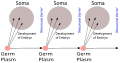 Weismann's Germ Plasm
 -
 August Weismann


