Emergency tourniquet: Difference between revisions
CSV import |
CSV import |
||
| Line 43: | Line 43: | ||
{{Medicine-stub}} | {{Medicine-stub}} | ||
{{Emergency-medicine-stub}} | {{Emergency-medicine-stub}} | ||
<gallery> | |||
File:Improvised_tourniquet.jpg|Improvised tourniquet | |||
File:Tourniquet.jpeg|Tourniquet | |||
File:EMT_Emergency_&_Military_Tourniquet.jpg|EMT Emergency & Military Tourniquet | |||
File:Tourniquet_application.jpg|Tourniquet application | |||
File:US_Navy_100505-N-8377A-039_Quartermaster_2nd_Class_Caleb_Murray_works_with_two_members_of_the_Royal_Brunei_Navy_Support_Squadron,_demonstrating_the_proper_use_of_a_tourniquet.jpg|Demonstrating the proper use of a tourniquet | |||
</gallery> | |||
Latest revision as of 11:27, 18 February 2025
Emergency Tourniquet
An emergency tourniquet is a medical device used to control blood loss in traumatic injuries, particularly those affecting the limbs. It works by applying pressure to the affected area, thereby restricting blood flow and preventing further blood loss until medical help can be obtained.
History[edit]
The use of tourniquets dates back to the times of Ancient Greece, where they were used in surgical procedures. The modern emergency tourniquet, however, was developed during the World War I, where it was used to control bleeding in wounded soldiers on the battlefield.
Types of Emergency Tourniquets[edit]
There are several types of emergency tourniquets, including:
- Mechanical Tourniquets: These are typically used in surgical procedures. They consist of a cuff that is placed around the limb and inflated to apply pressure.
- Manual Tourniquets: These are often used in emergency situations. They can be made from a variety of materials, such as cloth or rubber, and are tightened around the limb using a stick or similar object.
- Pneumatic Tourniquets: These are similar to mechanical tourniquets, but use air pressure to apply the necessary pressure.
Usage[edit]
Emergency tourniquets are used in a variety of situations, including:
- Trauma Care: They are commonly used in trauma care to control bleeding in patients with severe injuries.
- Military Medicine: In the military, tourniquets are often used in battlefield situations to control bleeding in wounded soldiers.
- Outdoor Survival: In outdoor survival situations, a tourniquet can be a lifesaving tool if a person is injured and bleeding heavily.
Risks and Complications[edit]
While emergency tourniquets can be lifesaving, they also carry risks and potential complications. These include nerve damage, tissue death, and in extreme cases, loss of the limb. Therefore, they should only be used when absolutely necessary and should be applied by a trained professional whenever possible.
See Also[edit]

This emergency medicine related article is a stub. You can help WikiMD by expanding it.
-
 Improvised tourniquet
 -
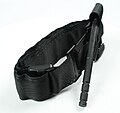 Tourniquet
 -
 EMT Emergency & Military Tourniquet
 -
 Tourniquet application
 -
 Demonstrating the proper use of a tourniquet


