Ethyl acetate: Difference between revisions
CSV import Tags: mobile edit mobile web edit |
CSV import |
||
| Line 24: | Line 24: | ||
[[Category:Esters]] | [[Category:Esters]] | ||
{{Chem-stub}} | {{Chem-stub}} | ||
== Ethyl_acetate == | |||
<gallery> | |||
File:Ethyl-acetate-from-xtal-3D-bs-17.png|3D structure of ethyl acetate | |||
File:Claisen_ethyl_acetate.png|Claisen condensation of ethyl acetate | |||
File:Vapour_pressure_ethyl_acetate.svg|Vapour pressure of ethyl acetate | |||
File:Heat_of_evaporation_ethyl_acetate.svg|Heat of evaporation of ethyl acetate | |||
</gallery> | |||
Latest revision as of 04:47, 18 February 2025
Ethyl Acetate is an organic compound that is commonly used as a solvent in a variety of industrial and chemical applications. It is a colorless liquid with a characteristic sweet smell and is the ester of ethanol and acetic acid.
Chemical Structure[edit]
Ethyl acetate (C4H8O2) is an ester that results from the condensation of ethanol and acetic acid, a reaction that is catalyzed by the presence of an acid. Its molecular structure consists of two carbon atoms, six hydrogen atoms, and one oxygen atom.
Production[edit]
Ethyl acetate is primarily produced via the esterification of ethanol and acetic acid in the presence of a strong acid. In this process, the acid acts as a catalyst to speed up the reaction. The reaction can be represented by the chemical equation:
CH3COOH + CH2CH3OH → CH3COOCH2CH3 + H2O
This reaction is an example of a condensation reaction, in which two molecules combine to form a larger molecule, with the loss of a small molecule (in this case, water).
Uses[edit]
Ethyl acetate is widely used as a solvent in many applications, including in paints, coatings, adhesives, and in the production of plastic. It is also used in the pharmaceutical industry as a solvent for the production of drugs and other medicinal products. In addition, ethyl acetate is used in the food industry as a flavoring agent and in the production of wine and beer.
Safety[edit]
While ethyl acetate is generally considered safe for use in many applications, it can be harmful if ingested or inhaled in large quantities. It can cause irritation to the eyes, skin, and respiratory tract, and prolonged exposure can lead to more serious health effects.
Environmental Impact[edit]
Ethyl acetate is considered to be a low toxicity compound and is not classified as a hazardous air pollutant. However, like all volatile organic compounds, it can contribute to the formation of ground-level ozone, a harmful air pollutant.

Ethyl_acetate[edit]
-
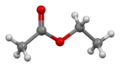 3D structure of ethyl acetate
 -
 Claisen condensation of ethyl acetate
 -
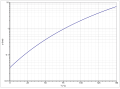 Vapour pressure of ethyl acetate
 -
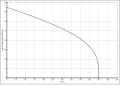 Heat of evaporation of ethyl acetate


