Castanea pumila: Difference between revisions
CSV import |
CSV import |
||
| Line 21: | Line 21: | ||
[[Category:Edible nuts and seeds]] | [[Category:Edible nuts and seeds]] | ||
{{plants-stub}} | {{plants-stub}} | ||
<gallery> | |||
File:Castanea_pumila_leaves_and_flowers.jpg|Leaves and flowers of Castanea pumila | |||
File:Castanea_pumila_leaves_and_seeds.jpg|Leaves and seeds of Castanea pumila | |||
</gallery> | |||
Latest revision as of 01:50, 18 February 2025
Castanea pumila, also known as the American chestnut or Allegheny chinkapin, is a species of chestnut native to the eastern United States. The tree is a member of the Fagaceae family and is known for its edible nuts.
Description[edit]
The Castanea pumila is a small, deciduous tree that typically grows to a height of 10-15 meters. The leaves are simple, alternate, and oblong-lanceolate in shape. The bark is gray-brown and smooth in young trees, becoming deeply furrowed with age. The flowers are monoecious, with separate male and female flowers on the same tree. The fruit is a spiny cupule containing one or two shiny, brown nuts.
Distribution and habitat[edit]
Castanea pumila is native to the southeastern United States, from southern Pennsylvania and New Jersey south to Florida, and west to eastern Texas and Oklahoma. It is typically found in dry, sandy soils in open woods, along the edges of forests, and in clearings.
Uses[edit]
The nuts of the Castanea pumila are edible and have been used as a food source by Native Americans and early settlers. The wood is hard and durable, making it useful for fence posts and other small items. The tree is also grown as an ornamental for its attractive foliage and edible nuts.
Conservation status[edit]
The Castanea pumila is not currently considered to be at risk of extinction. However, like the related American chestnut (Castanea dentata), it is susceptible to chestnut blight, a fungal disease that has decimated populations of chestnut trees in North America.
See also[edit]
This plant related article is a stub. You can help WikiMD by expanding it.
-
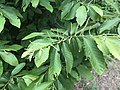 Leaves and flowers of Castanea pumila
 -
 Leaves and seeds of Castanea pumila


