Cyperus esculentus: Difference between revisions
CSV import Tags: mobile edit mobile web edit |
CSV import Tags: mobile edit mobile web edit |
||
| Line 29: | Line 29: | ||
[[Category:Medicinal plants]] | [[Category:Medicinal plants]] | ||
{{plant-stub}} | {{plant-stub}} | ||
== Cyperus esculentus == | |||
<gallery> | |||
File:Cyperus_esculentus_L._(AM_AK301430-1),_white_background.jpg|Cyperus esculentus L. on white background | |||
File:Chufa.jpg|Chufa | |||
File:Procés_de_cultiu_de_la_xufa.jpeg|Procés de cultiu de la xufa | |||
File:Cyperus_esculentus_NRCS-1.jpg|Cyperus esculentus NRCS | |||
File:Horchata_Chufas_from_Alboraya_for_sale_in_Valencia,_Spain.jpg|Horchata Chufas from Alboraya for sale in Valencia, Spain | |||
File:Cyperus_esculentus_MS_4388.jpg|Cyperus esculentus MS 4388 | |||
</gallery> | |||
Latest revision as of 21:05, 23 February 2025
Cyperus esculentus, also known as tiger nut, yellow nutsedge or earth almond, is a species of sedge native to warm temperate to subtropical regions of the Northern Hemisphere. It is considered a weed in some regions, but also has a long history of use for its edible tubers.
Description[edit]
Cyperus esculentus is a perennial plant that grows up to 90 cm tall. The leaves are linear, 3-10 mm wide, and the flowers are produced on spikes at the top of the stems. The tubers are small, round, and brown, resembling a small nut. They have a sweet, nutty flavor and can be eaten raw or cooked.
Distribution and habitat[edit]
Cyperus esculentus is native to the Old World, but has been introduced and naturalized in many other parts of the world, including North and South America, Australia, and New Zealand. It grows in a variety of habitats, but prefers moist, sandy soils.
Uses[edit]
The tubers of Cyperus esculentus have been used as a food source for thousands of years. They were a staple food in ancient Egypt and are still consumed in many parts of Africa, the Middle East, and Southern Europe. The tubers can be eaten raw, roasted, or ground into a flour. They are also used to make a sweet, milky drink called horchata in Spain.
In addition to their culinary uses, the tubers are also used in traditional medicine. They are believed to have diuretic, stimulant, and aphrodisiac properties.
Cultivation[edit]
Cyperus esculentus is easy to grow and can be cultivated in a variety of soil types. It prefers full sun and regular watering. The tubers can be harvested in the autumn, after the tops of the plants have died back.
See also[edit]
References[edit]
<references />
 | This plant article is a stub. You can help Wikipedia by adding missing information. |
Cyperus esculentus[edit]
-
 Cyperus esculentus L. on white background
 -
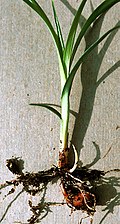 Chufa
Chufa -
 Procés de cultiu de la xufa
 -
 Cyperus esculentus NRCS
 -
 Horchata Chufas from Alboraya for sale in Valencia, Spain
 -
 Cyperus esculentus MS 4388
,_white_background.jpg)


