Coccinia grandis: Difference between revisions
CSV import Tags: mobile edit mobile web edit |
CSV import |
||
| Line 20: | Line 20: | ||
[[Category:Medicinal plants]] | [[Category:Medicinal plants]] | ||
[[Category:Tropical agriculture]] | [[Category:Tropical agriculture]] | ||
<gallery> | |||
File:Coccinia_grandis_fruit.jpg|Coccinia grandis fruit | |||
File:Baby_Watermelon_BNC.jpg|Baby Watermelon | |||
File:Ivy_gourd_in_India.JPG|Ivy gourd in India | |||
File:Coccinia_grandis11.JPG|Coccinia grandis | |||
File:Coccinia_grandis.jpg|Coccinia grandis | |||
File:దొండకాయ_ఉల్లిపాయ_కారం_కూర.jpg|Coccinia grandis dish | |||
File:Coccinia_grandis_(Cucurbitaceae).jpg|Coccinia grandis (Cucurbitaceae) | |||
</gallery> | |||
Latest revision as of 11:09, 18 February 2025
Coccinia grandis, also known as the ivy gourd, is a tropical vine belonging to the family Cucurbitaceae. It is native to Africa, Asia, and the Pacific Islands, and is considered an invasive species in some regions due to its rapid growth and ability to smother native vegetation.
Description[edit]
The Coccinia grandis is a perennial vine with tendrils, growing up to 3 meters in height. The leaves are simple, alternate, and have a heart-shaped base. The flowers are unisexual, with the male flowers being larger than the female ones. The fruit is a smooth, bright red berry when ripe, containing numerous seeds.
Cultivation and uses[edit]
Coccinia grandis is cultivated for its fruit, which is eaten as a vegetable in many parts of the world. The young leaves and shoots are also edible and are often used in stir-fry dishes. In traditional medicine, the plant is used to treat various ailments, including diabetes and skin diseases.
Invasive species[edit]
In some regions, such as Hawaii and the southern United States, Coccinia grandis is considered an invasive species. It can quickly overtake native vegetation, leading to a loss of biodiversity. Efforts are being made to control its spread and mitigate its impact on native ecosystems.
See also[edit]
| 🌱 | This Cucurbitaceae related article is a stub. |
-
 Coccinia grandis fruit
 -
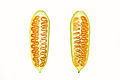 Baby Watermelon
 -
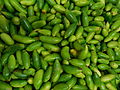 Ivy gourd in India
 -
 Coccinia grandis
 -
 Coccinia grandis
 -
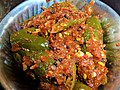 Coccinia grandis dish
 -
 Coccinia grandis (Cucurbitaceae)


.jpg)
