Body language: Difference between revisions
CSV import Tags: mobile edit mobile web edit |
CSV import |
||
| Line 37: | Line 37: | ||
[[Category:Body language]] | [[Category:Body language]] | ||
{{communication-stub}} | {{communication-stub}} | ||
<gallery> | |||
File:TwoWomenTalkingBodyLanguage.jpg|Two women talking, demonstrating body language | |||
File:Florence_Carlyle_The_Tiff.jpg|"The Tiff" by Florence Carlyle, depicting a moment of body language | |||
File:Personal_Space.svg|Diagram illustrating personal space in body language | |||
File:Mehrabian.png|Mehrabian's communication model related to body language | |||
File:In_Perfect_Congruence.jpg|In perfect congruence, showing aligned body language | |||
</gallery> | |||
Latest revision as of 04:43, 18 February 2025
Body language is a type of non-verbal communication in which physical behaviors, as opposed to words, are used to express or convey information. Such behavior includes facial expressions, body posture, gestures, eye movement, touch and the use of space. Body language exists in both animals and humans, but this article focuses on interpretations of human body language. It is also known as kinesics.
History[edit]
The study of body language is also known as kinesics (a term coined by anthropologist Ray Birdwhistell), which is a branch of anthropology that studies human behavior. Birdwhistell, considered the founder of this area of study, discovered that human expressions and gestures can be broken down into discrete units and analyzed in a similar way as linguistic syntax.
Types of Body Language[edit]
Body language can be divided into several types:
- Emblems: These are signals that can be translated directly into words such as the "OK" sign.
- Illustrators: These are signals that accompany speech to illustrate or highlight the message, such as pointing while stating directions.
- Regulators: These are signals used to give feedback or control the interaction or communication between people, such as nodding to indicate that you're listening.
- Adaptors: These are behaviors that usually occur without conscious awareness, often acting as a way to manage stress or discomfort, such as fidgeting.
Interpretation[edit]
Interpreting body language can be complicated. Many factors also influence the meaning of a particular body gesture or posture, including the context, the relationship between communicators, and the individual characteristics of the communicators.
Cultural Differences[edit]
Body language has different meanings in different cultures. For example, in some cultures, making eye contact is considered rude, while in others it is a sign of confidence and respect.
See Also[edit]
References[edit]
<references group="" responsive="1"></references>
This communication related article is a stub. You can help WikiMD by expanding it.
-
 Two women talking, demonstrating body language
 -
 "The Tiff" by Florence Carlyle, depicting a moment of body language
 -
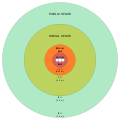 Diagram illustrating personal space in body language
 -
 Mehrabian's communication model related to body language
 -
 In perfect congruence, showing aligned body language


