Black grouse: Difference between revisions
CSV import Tags: mobile edit mobile web edit |
CSV import Tags: mobile edit mobile web edit |
||
| Line 20: | Line 20: | ||
[[Category:Grouse]] | [[Category:Grouse]] | ||
{{Bird-stub}} | {{Bird-stub}} | ||
<gallery> | |||
File:Black Grouse Nationalpark Bayerischer Wald.jpg|Black Grouse Nationalpark Bayerischer Wald | |||
File:Tétras lyre MHNT.jpg|Tétras lyre MHNT | |||
File:Birkhahn.jpg|Birkhahn | |||
File:Tetrao tetrix from ja.jpg|Tetrao tetrix from ja | |||
File:Teeri.jpg|Teeri | |||
</gallery> | |||
Latest revision as of 17:54, 3 March 2025
Black Grouse (Lyrurus tetrix) is a large bird in the grouse family. It is a sedentary species, breeding across northern Eurasia in moorland and bog areas near to woodland, mostly boreal. The black grouse is closely related to the caucasian grouse.
Description[edit]
The Black Grouse is characterized by its large size, with males reaching up to 53 centimeters in length and females up to 40 centimeters. The male is distinguished by its black plumage, lyre-shaped tail, and a distinctive white wingbar. The female, or hen, is smaller, with brown plumage, a short tail, and no wingbar.
Distribution and Habitat[edit]
The Black Grouse is native to the boreal forests of northern Eurasia, from Scandinavia to Siberia. It prefers habitats that are a mix of forest, moorland, and bog, and is often found near woodland edges.
Behaviour and Ecology[edit]
The Black Grouse is a sedentary species, with most individuals remaining within a few kilometers of their hatching site. Males are polygamous, and during the breeding season, they gather at traditional display sites, known as leks, to compete for the attention of females.
Conservation[edit]
The Black Grouse has been classified as Least Concern by the International Union for Conservation of Nature (IUCN). However, in some parts of its range, populations are declining due to habitat loss and hunting.
See Also[edit]

-
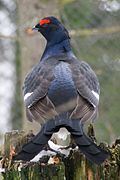 Black Grouse Nationalpark Bayerischer Wald
 -
 Tétras lyre MHNT
 -
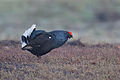 Birkhahn
 -
 Tetrao tetrix from ja
 -
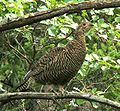 Teeri
Teeri


