Boiling point: Difference between revisions
CSV import |
CSV import |
||
| Line 32: | Line 32: | ||
[[Category:Phase transitions]] | [[Category:Phase transitions]] | ||
{{thermodynamics-stub}} | {{thermodynamics-stub}} | ||
<gallery> | |||
File:Boilingkettle.jpg|Boiling_point | |||
File:11._Температурата_и_вриењето_на_течност.ogv|Boiling_point | |||
File:vapor_pressure_chart.svg|Boiling_point | |||
File:Boiling_point_vs_molar_mass_graph.png|Boiling_point | |||
File:Butane-3D-balls.png|Boiling_point | |||
File:Isobutane-3D-balls.png|Boiling_point | |||
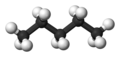
File:Pentane-3D-balls.png|Boiling_point | |||
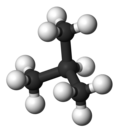
File:Isopentane-3D-balls.png|Boiling_point | |||
File:Neopentane-3D-balls.png|Boiling_point | |||
File:Binary_Boiling_Point_Diagram_new.svg|Boiling_point | |||
</gallery> | |||
Latest revision as of 12:16, 18 February 2025
Boiling Point
The boiling point of a substance is the temperature at which it changes state from a liquid to a gas throughout the bulk of the liquid. At the boiling point, the vapor pressure of the liquid equals the pressure surrounding the liquid, enabling bubbles of vapor to form without being crushed. A substance's boiling point depends on pressure and is usually specified at standard pressure.
Determination of Boiling Point[edit]
The boiling point of a liquid is typically determined using a simple distillation apparatus. The liquid is heated until it begins to vaporize, and the temperature at which this occurs is recorded as the boiling point.
Factors Affecting Boiling Point[edit]
Several factors can affect the boiling point of a substance. These include:
- Pressure: The boiling point of a liquid decreases with decreasing pressure. This is why water boils at a lower temperature at higher altitudes, where the atmospheric pressure is lower.
- Impurities: The presence of non-volatile impurities such as salts or other solutes can elevate the boiling point of a liquid, a phenomenon known as boiling point elevation.
- Intermolecular forces: Stronger intermolecular forces result in higher boiling points. For example, hydrogen bonding results in a higher boiling point because it requires more energy to break these bonds during vaporization.
Applications of Boiling Point[edit]
The boiling point has several practical applications. It is used in distillation processes to separate components of a liquid mixture. It is also used to identify substances, as each pure substance has a unique boiling point at a given pressure.
See Also[edit]

This article is a thermodynamics-related stub. You can help WikiMD by expanding it!
-
 Boiling_point
 -
 Boiling_point
 -
 Boiling_point
 -
 Boiling_point
 -
 Boiling_point
 -
 Boiling_point
 -
 Boiling_point
 -
 Boiling_point
 -
 Boiling_point
 -
 Boiling_point


