Axial mesoderm: Difference between revisions
CSV import Tags: mobile edit mobile web edit |
CSV import |
||
| Line 21: | Line 21: | ||
[[Category:Vertebrate anatomy]] | [[Category:Vertebrate anatomy]] | ||
{{biology-stub}} | {{biology-stub}} | ||
== Axial_mesoderm == | |||
<gallery> | |||
File:Gray19_with_color.png|Gray19 with color | |||
</gallery> | |||
Latest revision as of 23:56, 24 February 2025
Axial Mesoderm is a fundamental component of the embryonic development process in vertebrates. It is one of the three primary types of mesoderm that originate from the gastrulation process, the other two being the paraxial mesoderm and the lateral plate mesoderm.
Formation[edit]
The axial mesoderm, also known as the chordamesoderm, forms along the midline of the embryo. It is derived from the primitive streak during the process of gastrulation. The cells of the axial mesoderm migrate towards the anterior end of the embryo, forming a structure known as the notochord.
Function[edit]
The axial mesoderm plays a crucial role in the formation of the central nervous system. It induces the overlying ectoderm to form the neural plate, which eventually folds to form the neural tube. This process is known as neural induction. The notochord, derived from the axial mesoderm, serves as the primary axial support of the embryo before the development of the vertebral column.
Clinical Significance[edit]
Abnormalities in the formation of the axial mesoderm can lead to a variety of congenital disorders. These include spina bifida, a condition where the neural tube fails to close completely, and situs inversus, a condition where the major visceral organs are reversed or mirrored from their normal positions.
See Also[edit]

Axial_mesoderm[edit]
-
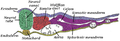 Gray19 with color

