Asimina parviflora: Difference between revisions
CSV import Tags: mobile edit mobile web edit |
CSV import |
||
| Line 21: | Line 21: | ||
[[Category:Flora of the Southeastern United States]] | [[Category:Flora of the Southeastern United States]] | ||
{{plant-stub}} | {{plant-stub}} | ||
<gallery> | |||
File:Asimina_parviflora.jpg|Asimina parviflora | |||
File:Asimina_parviflora_leave.jpg|Asimina parviflora leaves | |||
File:Asimina_parviflora_flower.jpg|Asimina parviflora flower | |||
File:Asimina_parviflora_fruit.jpg|Asimina parviflora fruit | |||
File:Asimina_parviflora_bush.jpg|Asimina parviflora bush | |||
</gallery> | |||
Latest revision as of 04:53, 18 February 2025
Asimina parviflora, commonly known as the smallflower pawpaw, is a species of plant in the Annonaceae family. It is native to the southeastern United States, where it is found in a variety of habitats, including forests, woodlands, and grasslands.
Description[edit]
Asimina parviflora is a small, deciduous shrub that typically grows to a height of 1–3 meters. The leaves are alternate, simple, and oblong to elliptic in shape. The flowers are small and inconspicuous, with six white to cream-colored petals. The fruit is a large, edible berry that is yellowish-green in color when ripe.
Distribution and habitat[edit]
Asimina parviflora is found throughout the southeastern United States, from Virginia south to Florida and west to Texas. It is most common in the Coastal Plain region, but can also be found in the Piedmont and Appalachian Mountains. It grows in a variety of habitats, including forests, woodlands, and grasslands.
Ecology[edit]
Asimina parviflora is a host plant for the Zebra Swallowtail Butterfly, which lays its eggs on the leaves. The larvae then feed on the leaves, gaining protection from predators due to the toxic compounds present in the plant.
Cultivation[edit]
Asimina parviflora is occasionally grown as an ornamental plant for its attractive foliage and edible fruit. It prefers a sunny to partially shaded location and well-drained soil.
See also[edit]

-
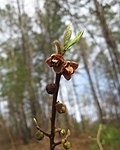 Asimina parviflora
 -
 Asimina parviflora leaves
 -
 Asimina parviflora flower
 -
 Asimina parviflora fruit
 -
 Asimina parviflora bush


