Silphium: Difference between revisions
CSV import Tags: mobile edit mobile web edit |
CSV import |
||
| Line 37: | Line 37: | ||
[[Category:Ancient history]] | [[Category:Ancient history]] | ||
[[Category:History of Libya]] | [[Category:History of Libya]] | ||
<gallery> | |||
File:Silphium.jpg|Silphium | |||
File:Magas as Ptolemaic governor, first reign, circa 300-282 or 275 BC Didrachm.jpg|Magas as Ptolemaic governor | |||
File:Weighing and loading of Silphium at Cyrene. Wellcome L0002417.jpg|Weighing and loading of Silphium at Cyrene | |||
File:Silphium, Evans, The Palace of Minos at Knossos, 1921.png|Silphium, Evans, The Palace of Minos at Knossos | |||
File:Greek Psi straight.svg|Greek Psi | |||
File:Cyrenecoin.jpg|Cyrene coin | |||
File:Illustration Heracleum sphondylium0.jpg|Illustration Heracleum sphondylium | |||
</gallery> | |||
Latest revision as of 01:13, 20 February 2025
Silphium (also known as silphion, laserwort, or laser) was a plant species that was used in Classical antiquity as a seasoning and as a medicine. It was praised by Greek and Roman authors for its culinary and medicinal properties, and it was one of the essential commodities in the Mediterranean trade until it became extinct.
History[edit]
Silphium was an important species in the ancient North African city of Cyrene, where it was used as a cash crop. The plant was so critical to the Cyrenian economy that it appeared on many of their coins. Despite attempts to cultivate it in other regions, it grew only in a narrow coastal area in Cyrene.
Description[edit]
The exact identity of silphium is unclear. It is generally believed to be a now-extinct plant of the genus Ferula, possibly a variety of Giant Fennel. The silphium plant was a type of fennel, with thick stalks and small, yellow flowers. Its heart-shaped seeds were particularly valued.
Uses[edit]
Culinary[edit]
In the kitchen, silphium was used as a seasoning. Its taste was described as a richly aromatic combination that was something between garlic and celery. The juice extracted from the plant was used in many recipes in Ancient Rome and Ancient Greece.
Medicinal[edit]
Medicinally, silphium was used for various purposes. It was said to have been effective in treating cough, sore throat, fever, indigestion, aches and pains, warts, and all kinds of maladies. It was also used as a contraceptive, which may have contributed to its extinction.
Extinction[edit]
The last known reference to silphium is from the 4th century AD. It is believed to have become extinct due to overharvesting, combined with a possible climate change. Its loss was a significant blow to the economy of Cyrene.
See also[edit]
References[edit]
<references />

-
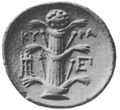 Silphium
 -
 Magas as Ptolemaic governor
 -
 Weighing and loading of Silphium at Cyrene
 -
 Silphium, Evans, The Palace of Minos at Knossos
 -
 Greek Psi
 -
Cyrene coin
-
 Illustration Heracleum sphondylium


