Quantum mechanics: Difference between revisions
CSV import |
CSV import |
||
| Line 29: | Line 29: | ||
[[Category:Quantum Mechanics]] | [[Category:Quantum Mechanics]] | ||
{{physics-stub}} | {{physics-stub}} | ||
== Quantum mechanics == | |||
<gallery> | |||
File:Hydrogen_Density_Plots.png|Hydrogen Density Plots | |||
File:Double-slit.svg|Double-slit | |||
File:QuantumTunnel.jpg|Quantum Tunnel | |||
File:Atomic-orbital-clouds_spd_m0.png|Atomic-orbital-clouds spd m0 | |||
File:Guassian_Dispersion.gif|Guassian Dispersion | |||
File:Infinite_potential_well.svg|Infinite potential well | |||
File:QuantumHarmonicOscillatorAnimation.gif|Quantum Harmonic Oscillator Animation | |||
File:Mach-Zehnder_interferometer.svg|Mach-Zehnder interferometer | |||
File:String_Vibrations.gif|String Vibrations | |||
File:Schroedingers_cat_film.svg|Schroedingers cat film | |||
File:Max_Planck_(1858-1947).jpg|Max Planck (1858-1947) | |||
</gallery> | |||
Latest revision as of 21:38, 23 February 2025
Quantum Mechanics is a fundamental theory in physics that provides a description of the physical properties of nature at the scale of atoms and subatomic particles. It is the foundation of all quantum physics including quantum chemistry, quantum field theory, quantum technology, and quantum information science.
Introduction[edit]
Quantum mechanics differs from classical physics in that energy, momentum, angular momentum, and other quantities of a system are restricted to discrete values (quantization), objects have characteristics of both particles and waves (wave-particle duality), and there are limits to the precision with which quantities can be known (uncertainty principle).
History[edit]
The development of quantum mechanics was initially motivated by two observations which all classical physics could not explain. The first was the black body radiation problem which was first proposed by Max Planck in 1900. He suggested that the energy in electromagnetic waves could only be released in 'packets' of energy. In 1905, Albert Einstein interpreted Planck's quantum hypothesis realistically and used it to explain the photoelectric effect. The second was the spectral lines problem that was solved by Niels Bohr with the introduction of the Bohr model of the atom in 1913.
Principles[edit]
Quantum mechanics is a significant part of understanding the universe and its workings, as it provides a mathematical description of much of the dual particle-like and wave-like behavior and interactions of energy and matter. It introduces a critical change to the fundamental understanding of physics, with two main principles:
1. Superposition Principle: A physical system - such as an electron in an atom - exists in all its theoretically possible states simultaneously; but, when measured or observed, it gives a result corresponding to only one of the possible configurations.
2. Uncertainty Principle: This is one of the most famous (and probably misunderstood) ideas in physics. It tells us that there is a fuzziness in nature, a fundamental limit to what we can know about the behavior of quantum particles and, therefore, the smallest scales of nature. Of these scales, the most we can hope for is to calculate probabilities for where things are and how they will behave.
Applications[edit]
Quantum mechanics has been instrumental in understanding the behavior of particles at the atomic and subatomic level. It has found wide applications in the development of electronic devices such as transistors and semiconductors. It is also fundamental in the modern field of particle physics.
See Also[edit]
References[edit]
<references />

Quantum mechanics[edit]
-
Hydrogen Density Plots
-
Double-slit
-
Quantum Tunnel
-
Atomic-orbital-clouds spd m0
-
Guassian Dispersion
-
Infinite potential well
-
Quantum Harmonic Oscillator Animation
-
 Mach-Zehnder interferometer
 -
 String Vibrations
 -
 Schroedingers cat film
 -
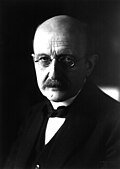 Max Planck (1858-1947)


.jpg)


