Queen Victoria: Difference between revisions
CSV import Tags: mobile edit mobile web edit |
CSV import |
||
| Line 21: | Line 21: | ||
{{UK-bio-stub}} | {{UK-bio-stub}} | ||
{{royalty-stub}} | {{royalty-stub}} | ||
<gallery> | |||
File:Queen_Victoria_by_Bassano.jpg|Queen Victoria by Bassano | |||
File:Sir_William_Beechey_(1753-1839)_-_Victoria,_Duchess_of_Kent,_(1786-1861)_with_Princess_Victoria,_(1819-1901)_-_RCIN_407169_-_Royal_Collection.jpg|Victoria, Duchess of Kent with Princess Victoria by Sir William Beechey | |||
File:Denning,_Stephen_Poyntz_-_Princess_Victoria_aged_Four_-_Google_Art_Project.jpg|Princess Victoria aged Four by Stephen Poyntz Denning | |||
File:Princess_Victoria_and_Dash_by_George_Hayter.jpg|Princess Victoria and Dash by George Hayter | |||
File:Victoria_sketch_1835.jpg|Victoria sketch 1835 | |||
File:Victoriatothrone.jpg|Victoria to throne | |||
File:Sir_George_Hayter_(1792-1871)_-_Queen_Victoria_(1819-1901)_-_RCIN_401213_-_Royal_Collection.jpg|Queen Victoria by Sir George Hayter | |||
File:Victoria_Marriage01.jpg|Victoria Marriage | |||
File:Edward_Oxford_shoots_at_H._M._the_Queen,_1840.jpg|Edward Oxford shoots at H. M. the Queen, 1840 | |||
File:Winterhalter_-_Queen_Victoria_1843.jpg|Queen Victoria 1843 by Winterhalter | |||
File:Queen_Victoria_the_Princess_Royal_Victoria_c1844-5.png|Queen Victoria the Princess Royal Victoria c1844-5 | |||
File:Queen_Victoria_Prince_Albert_and_their_nine_children.JPG|Queen Victoria, Prince Albert and their nine children | |||
</gallery> | |||
Latest revision as of 21:18, 23 February 2025
Queen Victoria (24 May 1819 – 22 January 1901) was the Queen of the United Kingdom of Great Britain and Ireland from 20 June 1837 until her death in 1901. Known as the Victorian era, her reign of 63 years and seven months was longer than any previous British monarch. It was a period of industrial, cultural, political, scientific, and military changes within the United Kingdom, and was marked by a great expansion of the British Empire.
Early Life[edit]
Victoria was born at Kensington Palace, London, on 24 May 1819. She was the only daughter of Edward, Duke of Kent, and Victoria Maria Louisa of Saxe-Coburg. Her father died shortly after her birth, making Victoria a direct heir to the throne. She was raised under close supervision by her mother and her comptroller, Sir John Conroy.
Ascension to the Throne[edit]
Victoria became queen at the age of 18, following the death of her uncle, King William IV, in 1837. Her coronation took place on 28 June 1838. As a young queen, Victoria was eager to have an influence on British policy, but she was often frustrated by the constraints of her constitutional role and the willingness of her ministers to ignore her.
Marriage and Family[edit]
In 1840, Victoria married her first cousin, Prince Albert of Saxe-Coburg and Gotha. Their marriage produced nine children, all of whom married into various European royal and noble families. Prince Albert's death in 1861 was a devastating blow to Victoria, and she entered a period of deep mourning.
Later Reign and Death[edit]
During her later years, Victoria became the symbol of the British Empire. Her Golden and Diamond Jubilees were celebrated with great enthusiasm in the UK and the wider Empire. Victoria died on 22 January 1901, at Osborne House on the Isle of Wight. She was succeeded by her eldest son, Edward VII.
Legacy[edit]
Queen Victoria's reign marked a period of significant growth and progress for the United Kingdom. The Victorian era is known for its industrial expansion, moral strictness, and burgeoning of the arts and sciences. Victoria herself is remembered as a symbol of empire, and her monuments and memorials are scattered throughout the former British Empire.
.svg) | This British biographical article is a stub. You can help WikiMD by expanding the page. |
 | This royalty-related article is a stub. You can help WikiMD by expanding the page. |
-
 Queen Victoria by Bassano
 -
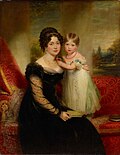 Victoria, Duchess of Kent with Princess Victoria by Sir William Beechey
 -
 Princess Victoria aged Four by Stephen Poyntz Denning
 -
 Princess Victoria and Dash by George Hayter
 -
 Victoria sketch 1835
 -
 Victoria to throne
 -
 Queen Victoria by Sir George Hayter
 -
 Victoria Marriage
 -
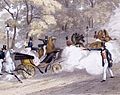 Edward Oxford shoots at H. M. the Queen, 1840
 -
 Queen Victoria 1843 by Winterhalter
 -
 Queen Victoria the Princess Royal Victoria c1844-5
 -
 Queen Victoria, Prince Albert and their nine children

_-_Victoria,_Duchess_of_Kent,_(1786-1861)_with_Princess_Victoria,_(1819-1901)_-_RCIN_407169_-_Royal_Collection.jpg)


_-_Queen_Victoria_(1819-1901)_-_RCIN_401213_-_Royal_Collection.jpg)


