Track and trace: Difference between revisions
CSV import |
CSV import |
||
| (One intermediate revision by the same user not shown) | |||
| Line 1: | Line 1: | ||
'''Track and trace''' is | == Track and Trace == | ||
[[File:RFID_Chip_004.JPG|thumb|An RFID chip used in track and trace systems]] | |||
[[File:Semacode-fr-wikipedia-org-wiki-pomme.png|thumb|A semacode used for tracking]] | |||
'''Track and trace''' refers to the process of identifying the past and current locations of an item or property, and obtaining and recording its history. This process is widely used in [[logistics]], [[supply chain management]], and [[inventory management]] to ensure the efficient movement and storage of goods. | |||
== Overview == | == Overview == | ||
Track and trace systems are designed to provide real-time information about the location and status of items. These systems often use technologies such as [[Radio-frequency identification|RFID]], [[barcode]]s, and [[GPS]] to collect data. The collected data is then processed and analyzed to provide insights into the movement and handling of goods. | |||
== Technologies Used == | |||
=== RFID === | |||
[[Radio-frequency identification|RFID]] technology uses electromagnetic fields to automatically identify and track tags attached to objects. An RFID system consists of a tag, which is a small radio transponder, a radio receiver, and a transmitter. When triggered by an electromagnetic interrogation pulse from a nearby RFID reader device, the tag transmits digital data, usually an identifying inventory number, back to the reader. | |||
=== Barcodes === | |||
[[Barcode]]s are optical, machine-readable representations of data. They are widely used in track and trace systems to identify products and manage inventory. Barcodes can be scanned using a barcode reader or a smartphone with a camera. | |||
=== GPS === | |||
[[Global Positioning System|GPS]] technology is used to determine the precise location of an object. In track and trace systems, GPS is often used to track the movement of vehicles and shipments in real-time. | |||
== Applications == | |||
Track and trace systems are used in various industries, including: | |||
* '''Healthcare''': To track the distribution of pharmaceuticals and medical devices. | |||
* '''Retail''': To manage inventory and prevent theft. | |||
* '''Manufacturing''': To monitor the production process and ensure quality control. | |||
* '''Transportation''': To track the movement of goods and optimize delivery routes. | |||
== Benefits == | == Benefits == | ||
The implementation of track and trace systems offers several benefits, such as: | |||
* Improved inventory management | |||
* Enhanced supply chain visibility | |||
* Reduced theft and loss | |||
* Increased efficiency in logistics operations | |||
== Challenges == | == Challenges == | ||
Despite | Despite their benefits, track and trace systems face several challenges, including: | ||
* High implementation costs | |||
* Data privacy concerns | |||
* Integration with existing systems | |||
== | == Related Pages == | ||
* [[Supply chain management]] | * [[Supply chain management]] | ||
* [[Logistics]] | * [[Logistics]] | ||
* [[ | * [[Inventory management]] | ||
== References == | |||
{{Reflist}} | |||
[[Category:Supply chain management]] | |||
[[Category:Logistics]] | [[Category:Logistics]] | ||
<gallery> | |||
File:RFID_Chip_004.JPG|RFID Chip | |||
File:Semacode-fr-wikipedia-org-wiki-pomme.png|Semacode | |||
</gallery> | |||
Latest revision as of 00:59, 18 February 2025
Track and Trace[edit]


Track and trace refers to the process of identifying the past and current locations of an item or property, and obtaining and recording its history. This process is widely used in logistics, supply chain management, and inventory management to ensure the efficient movement and storage of goods.
Overview[edit]
Track and trace systems are designed to provide real-time information about the location and status of items. These systems often use technologies such as RFID, barcodes, and GPS to collect data. The collected data is then processed and analyzed to provide insights into the movement and handling of goods.
Technologies Used[edit]
RFID[edit]
RFID technology uses electromagnetic fields to automatically identify and track tags attached to objects. An RFID system consists of a tag, which is a small radio transponder, a radio receiver, and a transmitter. When triggered by an electromagnetic interrogation pulse from a nearby RFID reader device, the tag transmits digital data, usually an identifying inventory number, back to the reader.
Barcodes[edit]
Barcodes are optical, machine-readable representations of data. They are widely used in track and trace systems to identify products and manage inventory. Barcodes can be scanned using a barcode reader or a smartphone with a camera.
GPS[edit]
GPS technology is used to determine the precise location of an object. In track and trace systems, GPS is often used to track the movement of vehicles and shipments in real-time.
Applications[edit]
Track and trace systems are used in various industries, including:
- Healthcare: To track the distribution of pharmaceuticals and medical devices.
- Retail: To manage inventory and prevent theft.
- Manufacturing: To monitor the production process and ensure quality control.
- Transportation: To track the movement of goods and optimize delivery routes.
Benefits[edit]
The implementation of track and trace systems offers several benefits, such as:
- Improved inventory management
- Enhanced supply chain visibility
- Reduced theft and loss
- Increased efficiency in logistics operations
Challenges[edit]
Despite their benefits, track and trace systems face several challenges, including:
- High implementation costs
- Data privacy concerns
- Integration with existing systems
Related Pages[edit]
References[edit]
<references group="" responsive="1"></references>
-
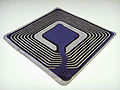 RFID Chip
 -
 Semacode
