Water safety: Difference between revisions
CSV import |
CSV import |
||
| Line 36: | Line 36: | ||
[[Category:Swimming]] | [[Category:Swimming]] | ||
{{safety-stub}} | {{safety-stub}} | ||
<gallery> | |||
File:Air-sea-rescue-falmouth.jpg|Air-sea rescue operation in Falmouth | |||
File:NZ_sea_rescue.jpg|New Zealand sea rescue | |||
File:Proper_Rescue_Method.jpg|Proper rescue method demonstration | |||
</gallery> | |||
Latest revision as of 01:28, 18 February 2025
Water safety refers to the procedures, precautions, and policies associated with safety in, on, and around bodies of water, where there is a risk of injury or drowning. It has applications in several occupations, sports, and recreational activities.
Overview[edit]
Water safety involves the understanding and application of safety measures to prevent and respond to water-related accidents, injuries, and emergencies. It is a crucial aspect of various activities such as swimming, boating, fishing, and other water sports. Water safety also includes knowledge of First Aid and CPR, as these skills can be life-saving in water-related emergencies.
Importance[edit]
Water safety is essential due to the inherent risks associated with water activities. Drowning is a leading cause of accidental death, particularly among children. Even non-fatal drowning incidents can result in significant injury, including brain damage. Therefore, understanding and practicing water safety can prevent accidents and save lives.
Water Safety Measures[edit]
Water safety measures include learning to swim, understanding the dangers of water bodies, using safety equipment like life jackets, and knowing emergency procedures.
Swimming Skills[edit]
Learning to swim is a fundamental water safety measure. It not only enables individuals to enjoy water-based activities safely but also equips them to handle emergencies.
Awareness of Water Dangers[edit]
Understanding the dangers associated with different water bodies, such as oceans, lakes, rivers, and swimming pools, is crucial. This includes knowledge of currents, tides, depth, temperature, and aquatic life.
Use of Safety Equipment[edit]
Using safety equipment like life jackets, helmets, and ropes is essential during water activities, especially boating or water sports.
Emergency Procedures[edit]
Knowing emergency procedures, including how to call for help, perform CPR, and use a defibrillator, can be life-saving in water-related emergencies.
Water Safety Education[edit]
Water Safety Education is a key aspect of promoting water safety. It involves teaching individuals, especially children, about the risks associated with water and the measures to prevent accidents and handle emergencies.
See Also[edit]

This safety related article is a stub. You can help WikiMD by expanding it.
-
 Air-sea rescue operation in Falmouth
 -
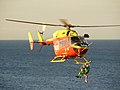 New Zealand sea rescue
 -
 Proper rescue method demonstration


