Underwater breathing apparatus: Difference between revisions
CSV import |
No edit summary |
||
| (4 intermediate revisions by the same user not shown) | |||
| Line 1: | Line 1: | ||
''' | An '''underwater breathing apparatus''' is a device that allows humans to breathe underwater. These devices are essential for [[scuba diving]], [[underwater exploration]], and various [[commercial diving]] operations. The development of underwater breathing apparatuses has significantly advanced the ability to explore and work in underwater environments. | ||
[[File:Водолазные_костюмы.jpg|Underwater breathing apparatus|thumb]] | |||
[[File:Diver_on_the_wreck_of_the_Aster_PB182648.JPG|Diver on the wreck of the Aster|left|thumb]] | |||
[[File:USMC_combatant_diving_(2nd_Recon_Bn).jpg|USMC combatant diving|thumb]] | |||
== | == Types of Underwater Breathing Apparatus == | ||
=== Scuba === | === Scuba === | ||
[[File:Diver_on_the_wreck_of_the_Aster_PB182648.JPG|thumb|A diver using scuba equipment on a shipwreck.]] | |||
The term "[[scuba]]" stands for "self-contained underwater breathing apparatus." Scuba equipment allows divers to carry their own source of breathing gas, usually compressed air, enabling them to stay underwater for extended periods. Scuba systems typically include a tank, a [[regulator]], and a [[buoyancy compensator]]. | |||
[[ | === Surface-Supplied Diving === | ||
Surface-supplied diving involves a diver being connected to the surface by a hose that supplies breathing gas. This method is commonly used in [[commercial diving]] and [[military diving]] operations. The diver wears a helmet or full-face mask, and the gas is supplied from the surface, allowing for longer dives and greater depths. | |||
=== | === Rebreathers === | ||
Rebreathers are a type of underwater breathing apparatus that recycles the diver's exhaled gas. This system removes carbon dioxide and replenishes oxygen, allowing for more efficient use of the breathing gas. Rebreathers are used in both recreational and technical diving due to their ability to extend dive times and reduce gas consumption. | |||
=== Atmospheric Diving Suits === | |||
[[File:Newtsuit_atmospheric_diving_suit.jpg|thumb|The Newtsuit, an example of an atmospheric diving suit.]] | |||
Atmospheric diving suits are rigid suits that maintain surface pressure inside, allowing divers to work at great depths without being subjected to high external pressures. These suits are used in deep-sea exploration and underwater construction. | |||
=== | == History == | ||
The development of underwater breathing apparatuses dates back to ancient times, with early attempts including simple breath-holding and the use of hollow reeds. The modern era of diving began in the 19th century with the invention of the [[diving bell]] and the [[hard hat diving]] suit. | |||
[[ | == Applications == | ||
Underwater breathing apparatuses are used in a variety of fields, including: | |||
* [[Recreational diving]] | |||
* [[Scientific research]] | |||
* [[Underwater archaeology]] | |||
* [[Military operations]] | |||
* [[Commercial diving]] | |||
== Gallery == | |||
<gallery> | |||
File:Commercial_diving_equipment_at_Eudi_Show_2006_adventurediving.it.jpg|Commercial diving equipment at Eudi Show 2006 | |||
File:Immersion_Suite.JPG|Immersion Suite | |||
</gallery> | |||
== | == Related Pages == | ||
* [[Scuba diving]] | |||
* [[Diving equipment]] | |||
* [[Rebreather]] | |||
* [[Commercial diving]] | |||
* [[Atmospheric diving suit]] | |||
* | == References == | ||
* "The History of Diving," Diving Heritage, accessed October 2023. | |||
* | * "Scuba Diving Explained," Divers Alert Network, accessed October 2023. | ||
* | * "Rebreathers: A Technical Overview," Technical Diving Magazine, accessed October 2023. | ||
[[Category:Diving equipment]] | [[Category:Diving equipment]] | ||
Latest revision as of 04:30, 29 March 2025
An underwater breathing apparatus is a device that allows humans to breathe underwater. These devices are essential for scuba diving, underwater exploration, and various commercial diving operations. The development of underwater breathing apparatuses has significantly advanced the ability to explore and work in underwater environments.


.jpg)
Types of Underwater Breathing Apparatus[edit]
Scuba[edit]
The term "scuba" stands for "self-contained underwater breathing apparatus." Scuba equipment allows divers to carry their own source of breathing gas, usually compressed air, enabling them to stay underwater for extended periods. Scuba systems typically include a tank, a regulator, and a buoyancy compensator.
Surface-Supplied Diving[edit]
Surface-supplied diving involves a diver being connected to the surface by a hose that supplies breathing gas. This method is commonly used in commercial diving and military diving operations. The diver wears a helmet or full-face mask, and the gas is supplied from the surface, allowing for longer dives and greater depths.
Rebreathers[edit]
Rebreathers are a type of underwater breathing apparatus that recycles the diver's exhaled gas. This system removes carbon dioxide and replenishes oxygen, allowing for more efficient use of the breathing gas. Rebreathers are used in both recreational and technical diving due to their ability to extend dive times and reduce gas consumption.
Atmospheric Diving Suits[edit]

Atmospheric diving suits are rigid suits that maintain surface pressure inside, allowing divers to work at great depths without being subjected to high external pressures. These suits are used in deep-sea exploration and underwater construction.
History[edit]
The development of underwater breathing apparatuses dates back to ancient times, with early attempts including simple breath-holding and the use of hollow reeds. The modern era of diving began in the 19th century with the invention of the diving bell and the hard hat diving suit.
Applications[edit]
Underwater breathing apparatuses are used in a variety of fields, including:
- Recreational diving
- Scientific research
- Underwater archaeology
- Military operations
- Commercial diving
Gallery[edit]
-
 Commercial diving equipment at Eudi Show 2006
 -
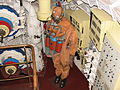 Immersion Suite


Related Pages[edit]
References[edit]
- "The History of Diving," Diving Heritage, accessed October 2023.
- "Scuba Diving Explained," Divers Alert Network, accessed October 2023.
- "Rebreathers: A Technical Overview," Technical Diving Magazine, accessed October 2023.
