Z-pinch: Difference between revisions
CSV import Tags: mobile edit mobile web edit |
CSV import |
||
| Line 26: | Line 26: | ||
[[Category:Nuclear fusion]] | [[Category:Nuclear fusion]] | ||
{{physics-stub}} | {{physics-stub}} | ||
<gallery> | |||
File:Z-pinch_H-gamma.jpg|Z-pinch H-gamma | |||
File:TWK_pinch.jpg|TWK pinch | |||
File:Kink_instability_at_Aldermaston.jpg|Kink instability at Aldermaston | |||
File:Pinchseta.JPG|Pinchseta | |||
</gallery> | |||
Latest revision as of 05:04, 18 February 2025
Z-pinch is a type of plasma confinement system that uses an electric current in the plasma to generate a magnetic field that compresses it. These systems were amongst the earliest studied for controlled thermonuclear fusion power systems.
History[edit]
The Z-pinch concept was first proposed and tested in the UK in the late 1940s by teams at Imperial College London and the Atomic Energy Research Establishment. Early work was promising, and pinch devices were adopted in the US and USSR. However, instabilities in the plasma quickly led to the abandonment of the concept in the early 1960s.
Principle[edit]
The name Z-pinch is a reference to the azimuthal magnetic field, which is aligned along the z-axis in a cylindrical coordinate system. The Z-pinch effect occurs when a current is driven through a plasma. The current generates a magnetic field that interacts with the current to produce a longitudinal magnetic field. This field constricts, or "pinches", the plasma into a smaller radius, increasing the plasma's pressure and temperature.
Applications[edit]
Z-pinch devices have been used in a variety of research applications. They have been used to study plasma physics, nuclear fusion, and astrophysical phenomena. They have also been used in practical applications such as X-ray generation and inertial confinement fusion research.
See also[edit]
References[edit]
<references />

-
 Z-pinch H-gamma
 -
 TWK pinch
 -
 Kink instability at Aldermaston
 -
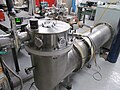 Pinchseta


