TGF beta signaling pathway: Difference between revisions
CSV import |
CSV import |
||
| Line 42: | Line 42: | ||
[[Category:Molecular biology]] | [[Category:Molecular biology]] | ||
{{biology-stub}} | {{biology-stub}} | ||
== TGF_beta_signaling_pathway == | |||
<gallery> | |||
File:TGFbeta_Pathway_1.svg|TGF-beta signaling pathway step 1 | |||
File:TGF_beta_pathway_2.svg|TGF-beta signaling pathway step 2 | |||
File:TGF_beta_pathway_step3.svg|TGF-beta signaling pathway step 3 | |||
File:TGF_beta_Pathway_step4.svg|TGF-beta signaling pathway step 4 | |||
File:Pathwaystep5.svg|TGF-beta signaling pathway step 5 | |||
</gallery> | |||
Latest revision as of 05:06, 18 February 2025
TGF beta signaling pathway is a cellular pathway that plays a crucial role in regulating a variety of biological processes, including cell growth, cell differentiation, apoptosis, and homeostasis. The pathway is named after its key component, the Transforming Growth Factor beta (TGF-β), a type of cytokine that controls proliferation, cellular differentiation, and other functions in most cells.
Overview[edit]
The TGF-β signaling pathway begins when TGF-β ligands bind to a type II receptor, which recruits and phosphorylates a type I receptor. The type I receptor then phosphorylates receptor-regulated SMADs (R-SMADs), which can now bind the coSMAD SMAD4. This complex accumulates in the cell nucleus where it acts as a transcription factor and participates in the regulation of target gene expression.
Components[edit]
TGF-β[edit]
Transforming Growth Factor beta (TGF-β) is a multifunctional cytokine belonging to the transforming growth factor superfamily that includes four different isoforms (TGF-β1, TGF-β2, TGF-β3, TGF-β4) and many other signaling proteins produced by all white blood cell lineages.
Type I and Type II Receptors[edit]
The TGF beta receptors are single pass serine/threonine kinase receptors. They are composed of two types: type I and type II. Both types are required for signal transduction.
SMAD Proteins[edit]
SMAD proteins are a family of proteins similar to the gene products of the Drosophila gene 'mothers against decapentaplegic' (Mad) and the C. elegans gene Sma. SMAD proteins are signal transducers and transcriptional modulators that mediate multiple signaling pathways.
Function[edit]
The TGF-β signaling pathway is involved in a wide range of cellular processes in both the adult organism and the developing embryo including cell growth, cell differentiation, apoptosis, cellular homeostasis and other cellular functions.
Clinical Significance[edit]
Alterations in the TGF-β signaling pathway have been implicated in a variety of diseases, including cancer, fibrosis, and autoimmune diseases.
See Also[edit]
References[edit]
<references group="" responsive="1"></references>

TGF_beta_signaling_pathway[edit]
-
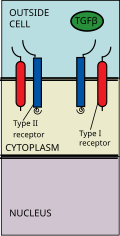 TGF-beta signaling pathway step 1
 -
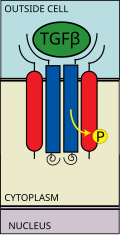 TGF-beta signaling pathway step 2
 -
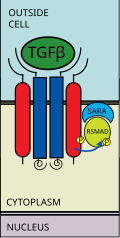 TGF-beta signaling pathway step 3
 -
 TGF-beta signaling pathway step 4
 -
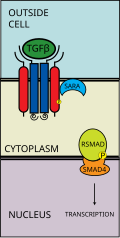 TGF-beta signaling pathway step 5


