Head mirror: Difference between revisions
CSV import |
CSV import |
||
| Line 22: | Line 22: | ||
[[Category:Otorhinolaryngology]] | [[Category:Otorhinolaryngology]] | ||
{{medical-equipment-stub}} | {{medical-equipment-stub}} | ||
<gallery> | |||
File:Stirnspiegel_HNO.jpg|Stirnspiegel HNO | |||
File:Head_mirror_in_use.png|Head mirror in use | |||
</gallery> | |||
Latest revision as of 23:53, 24 February 2025
Head mirror is a simple diagnostic device, traditionally used by physicians and healthcare professionals for the examination of a patient's ENT region. It is a circular concave mirror, worn on the forehead of the examiner, which reflects light into the patient's body cavities for better visibility.
History[edit]
The head mirror was first introduced in the 19th century by a French physician named Armand Trousseau. It was initially used for the examination of the throat and larynx, but its use was later expanded to include the examination of the ear and nasal cavities.
Design and Function[edit]
The head mirror is designed with a hole in the center, which the examiner looks through. The light is reflected off the mirror's concave surface, focusing it into a small, bright spot that can be directed into the patient's body cavities. This allows the examiner to see clearly without the need for additional lighting.
The head mirror is typically worn with a headband, allowing the examiner to adjust the position and angle of the mirror for optimal visibility. The mirror can be moved closer or further away from the patient's body, and tilted at different angles, to adjust the focus and direction of the light.
Use in Modern Medicine[edit]
While the head mirror is still used in some medical practices, it has largely been replaced by more modern diagnostic tools, such as endoscopes and otoscopes. These devices provide a more direct view of the patient's body cavities, and often include built-in lighting and magnification features.
However, the head mirror remains a valuable tool in medical education, where it is used to teach students about the principles of light reflection and focusing. It is also still used in some surgical procedures, particularly those involving the ear, nose, and throat.
See Also[edit]
 | This article related to medical equipment is a stub. You can help Wikipedia by adding missing information. |
-
 Stirnspiegel HNO
 -
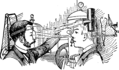 Head mirror in use


