Mechanism of diving regulators: Difference between revisions
CSV import |
CSV import |
||
| Line 32: | Line 32: | ||
[[Category:Underwater breathing apparatus]] | [[Category:Underwater breathing apparatus]] | ||
{{Scuba-stub}} | {{Scuba-stub}} | ||
<gallery> | |||
File:Scuba_regulator_2nd_stage_01.png|Mechanism_of_diving_regulators | |||
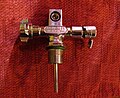
File:1964_US_DIVERS_type_"J"_scuba_cylinder_valve_(2).jpg|Mechanism_of_diving_regulators | |||
File:Left_side_cylinder_valve_for_barrel_seal_manifold_with_blanking_plug_PB128179.jpg|Mechanism_of_diving_regulators | |||
File:Scuba_block_adaptor_20160805_165041.jpg|Mechanism_of_diving_regulators | |||
File:Diving_cyinder_valve_DIN_insert_1_P5180281.JPG|Mechanism_of_diving_regulators | |||
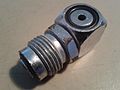
File:Adaptor_(yoke_to_DIN).jpg|Mechanism_of_diving_regulators | |||
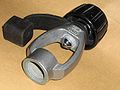
File:Parallel_thread_cylinder_valve_with_DIN_thread_attachment_point_and_plug_adaptor_P5190307.JPG|Mechanism_of_diving_regulators | |||
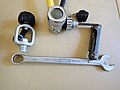
File:Parts_and_tools_to_convert_an_Apeks_first_stage_diving_regulator_from_DIN_to_Yoke_connector_P1240152.jpg|Mechanism_of_diving_regulators | |||
File:Aqua_lung.jpg|Mechanism_of_diving_regulators | |||
File:First_Stage_dissassembled.JPG|Mechanism_of_diving_regulators | |||
File:Diving_regulator_piston.png|Mechanism_of_diving_regulators | |||
File:Diving_regulator_diaphragm.PNG|Mechanism_of_diving_regulators | |||
</gallery> | |||
Latest revision as of 11:54, 18 February 2025
Mechanism of Diving Regulators
A diving regulator is a pressure-regulating device that reduces pressurized breathing gas to ambient pressure and delivers it to the diver. The gas may be air or one of a variety of specially blended breathing gases. The gas may be supplied from a scuba cylinder carried by the diver or via a hose from a compressor or high-pressure storage cylinders at the surface in surface-supplied diving.
Function[edit]
A diving regulator consists of one or more stages. The first stage reduces the high pressure in the cylinder to an intermediate pressure. The second stage reduces the intermediate pressure to ambient pressure. In single-hose regulators, the second stage is held in the diver's mouth by a mouthpiece. In twin-hose regulators the second stage is located in the cylinder valve or manifold, and the gas is supplied to the diver through two hoses, one for inhalation and one for exhalation.
First Stage[edit]
The first stage, which is attached directly to the diving cylinder, reduces the high pressure in the cylinder to an intermediate pressure of about 8 to 10 bar above the ambient pressure. The first stage has a mechanism, often a diaphragm or piston, which is affected by the difference between the intermediate pressure and the ambient pressure, and adjusts the flow of gas from the cylinder to maintain the intermediate pressure at the set level relative to ambient pressure.
Second Stage[edit]
The second stage reduces the intermediate pressure to ambient pressure. This stage also has a mechanism which responds to the pressure in the diver's mouth and supplies as much gas as the diver needs, at a pressure slightly above ambient pressure. This allows the diver to inhale and exhale naturally. The second stage has a purge button which allows the diver to fill the housing with gas, which can be useful to clear water out of the regulator.
Environmental Sealing[edit]
Some regulators are environmentally sealed to prevent water and contaminants from entering the first stage. This is particularly important in cold water, where water can freeze in the regulator, causing a free flow or locking the regulator shut.
Alternate Air Source[edit]
Most diving regulators also have an alternate air source, or octopus, which is a second second-stage regulator on the same system, for use in an emergency.
See Also[edit]
 | |
|---|---|
 |
 |
-
 Mechanism_of_diving_regulators
 -
 Mechanism_of_diving_regulators
 -
 Mechanism_of_diving_regulators
 -
 Mechanism_of_diving_regulators
 -
 Mechanism_of_diving_regulators
 -
 Mechanism_of_diving_regulators
 -
 Mechanism_of_diving_regulators
 -
 Mechanism_of_diving_regulators
 -
 Mechanism_of_diving_regulators
 -
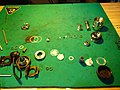 Mechanism_of_diving_regulators
 -
 Mechanism_of_diving_regulators
 -
 Mechanism_of_diving_regulators

.jpg)


.jpg)


