Methylsulfonylmethane: Difference between revisions
CSV import |
No edit summary |
||
| (2 intermediate revisions by the same user not shown) | |||
| Line 25: | Line 25: | ||
{{Chem-stub}} | {{Chem-stub}} | ||
{{medicine-stub}} | {{medicine-stub}} | ||
== Methylsulfonylmethane == | |||
<gallery> | |||
File:Me2SO2.png|Me2SO2 | |||
File:Dimethylsulfone-3D-vdW.png|Dimethylsulfone 3D vdW | |||
</gallery> | |||
Latest revision as of 00:41, 17 March 2025
Methylsulfonylmethane (MSM) is an organosulfur compound with the formula (CH3)2SO2. It is also known as dimethyl sulfone (DMSO2) or methyl sulfone, and is often sold as a dietary supplement. Its primary uses are as an anti-inflammatory agent and for joint health.
Chemistry[edit]
MSM is an organosulfur compound, which means it contains carbon and sulfur. It is a white, crystalline powder that is highly soluble in hot water and in a range of organic solvents. The compound is stable under normal conditions and has a relatively low melting point of 109 degrees Celsius.
Sources[edit]
MSM is found in small amounts in many foods and beverages, including milk, coffee, tea, green vegetables, and grains. It can also be produced industrially through the oxidation of dimethyl sulfoxide (DMSO).
Health Benefits[edit]
MSM is most commonly used as a dietary supplement for its anti-inflammatory properties and its ability to improve joint health. It has been shown to reduce pain and swelling in osteoarthritis, a common form of arthritis. Some studies also suggest that MSM may improve skin health and complexion, and may help with allergy relief.
Safety and Side Effects[edit]
MSM is generally considered safe for most people when taken by mouth or applied to the skin. However, it can cause some side effects, including nausea, diarrhea, bloating, fatigue, headache, insomnia, itching, or worsening of allergy symptoms.
See Also[edit]
References[edit]
<references />

This article is a medical stub. You can help WikiMD by expanding it!
Methylsulfonylmethane[edit]
-
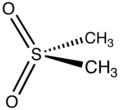 Me2SO2
 -
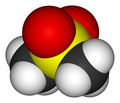 Dimethylsulfone 3D vdW


