John Snow: Difference between revisions
CSV import |
CSV import |
||
| (One intermediate revision by the same user not shown) | |||
| Line 1: | Line 1: | ||
'''John Snow''' (15 March 1813 – 16 June 1858) was an English physician and a leader in the development of [[anaesthesia]] and [[medical hygiene]]. He is considered one of the | '''John Snow''' (15 March 1813 – 16 June 1858) was an English [[physician]] and a leader in the development of [[anaesthesia]] and [[medical hygiene]]. He is considered one of the fathers of modern [[epidemiology]], in part because of his work in tracing the source of a [[cholera]] outbreak in [[Soho]], London, in 1854. | ||
== Early | == Early Life and Education == | ||
John Snow was born | John Snow was born in [[York]], England, on 15 March 1813. His father was a labourer, and Snow was the first of nine children. He was educated in York until he was 14, after which he was apprenticed to a [[surgeon]] in [[Newcastle upon Tyne]], where he first encountered cholera, which had reached Newcastle in 1831. | ||
Snow | == Medical Career == | ||
Snow moved to London to start his formal medical education at the [[Hunterian School of Medicine]] in 1836. He became a member of the [[Royal College of Surgeons]] in 1838 and later also joined the [[Royal College of Physicians]]. Snow developed an interest in the effects of [[anesthesia]] and was one of the first doctors to study and calculate dosages for [[ether]] and later [[chloroform]] to make surgery less painful and safer for patients. | |||
== | == Cholera Research == | ||
Snow's most significant and famous work was in the field of epidemiology and specifically his study of the 1854 Broad Street cholera outbreak. He hypothesized that cholera was spread by contaminated water and was able to demonstrate this by mapping cases of cholera in the Soho district. His studies showed that the majority of people who contracted cholera used a particular public water pump on Broad Street. After the handle of the pump was removed, the outbreak quickly subsided. | |||
His findings were initially met with skepticism, but they later influenced public health and led to changes in the water and waste systems of London, which led to similar changes in other cities, and a significant improvement in public health around the world. | |||
== Legacy == | == Legacy == | ||
John Snow's | John Snow's work is widely recognized in the field of public health. He is often regarded as one of the first individuals to use data to study the spread of disease. The [[John Snow Society]] is named in his honor, and there is a memorial to him at the site of the original Broad Street water pump. Snow's approach to data analysis and his application of statistical maps paved the way for modern epidemiology. | ||
== | == Death == | ||
John Snow died of a stroke on 16 June 1858 at the age of 45. His legacy continues to be celebrated in the fields of public health, epidemiology, and anesthesiology. | |||
[[Category:British physicians]] | |||
[[Category:Epidemiologists]] | |||
[[Category:People from York]] | |||
[[Category:1813 births]] | [[Category:1813 births]] | ||
[[Category:1858 deaths]] | [[Category:1858 deaths]] | ||
{{medicine-stub}} | |||
<gallery> | |||
File:John Snow.jpg|John Snow | |||
File:All Saints, North Street, York (4179098283).jpg|All Saints, North Street, York | |||
File:Barker--John Snow--1847.jpg|Barker--John Snow--1847 | |||
File:Cholera in London 1866.gif|Cholera in London 1866 | |||
File:Choleramaplondon1866.png|Cholera map London 1866 | |||
File:Snow-cholera-map-1.jpg|Snow cholera map 1 | |||
File:John Snow memorial and pub.jpg|John Snow memorial and pub | |||
File:JohnSnowBrompton.jpg|John Snow Brompton | |||
File:Dr John Snow (24023399742).jpg|Dr John Snow | |||
</gallery> | |||
Latest revision as of 01:43, 20 February 2025
John Snow (15 March 1813 – 16 June 1858) was an English physician and a leader in the development of anaesthesia and medical hygiene. He is considered one of the fathers of modern epidemiology, in part because of his work in tracing the source of a cholera outbreak in Soho, London, in 1854.
Early Life and Education[edit]
John Snow was born in York, England, on 15 March 1813. His father was a labourer, and Snow was the first of nine children. He was educated in York until he was 14, after which he was apprenticed to a surgeon in Newcastle upon Tyne, where he first encountered cholera, which had reached Newcastle in 1831.
Medical Career[edit]
Snow moved to London to start his formal medical education at the Hunterian School of Medicine in 1836. He became a member of the Royal College of Surgeons in 1838 and later also joined the Royal College of Physicians. Snow developed an interest in the effects of anesthesia and was one of the first doctors to study and calculate dosages for ether and later chloroform to make surgery less painful and safer for patients.
Cholera Research[edit]
Snow's most significant and famous work was in the field of epidemiology and specifically his study of the 1854 Broad Street cholera outbreak. He hypothesized that cholera was spread by contaminated water and was able to demonstrate this by mapping cases of cholera in the Soho district. His studies showed that the majority of people who contracted cholera used a particular public water pump on Broad Street. After the handle of the pump was removed, the outbreak quickly subsided.
His findings were initially met with skepticism, but they later influenced public health and led to changes in the water and waste systems of London, which led to similar changes in other cities, and a significant improvement in public health around the world.
Legacy[edit]
John Snow's work is widely recognized in the field of public health. He is often regarded as one of the first individuals to use data to study the spread of disease. The John Snow Society is named in his honor, and there is a memorial to him at the site of the original Broad Street water pump. Snow's approach to data analysis and his application of statistical maps paved the way for modern epidemiology.
Death[edit]
John Snow died of a stroke on 16 June 1858 at the age of 45. His legacy continues to be celebrated in the fields of public health, epidemiology, and anesthesiology.

-
 John Snow
 -
 All Saints, North Street, York
 -
 Barker--John Snow--1847
 -
 Cholera in London 1866
 -
 Cholera map London 1866
 -
 Snow cholera map 1
 -
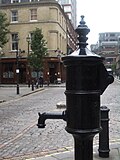 John Snow memorial and pub
 -
 John Snow Brompton
 -
 Dr John Snow

.jpg)


.jpg)
