Cyclin-dependent kinase: Difference between revisions
CSV import |
CSV import |
||
| Line 37: | Line 37: | ||
[[Category:RNA]] | [[Category:RNA]] | ||
{{biology-stub}} | {{biology-stub}} | ||
== Cyclin-dependent_kinase == | |||
<gallery> | |||
File:CDKs_in_cell_cycle.png|CDKs in cell cycle | |||
File:CDK2-Selective_inhibitor.png|CDK2-Selective inhibitor | |||
</gallery> | |||
Latest revision as of 02:12, 27 February 2025
Cyclin-dependent kinases (CDKs) are a group of protein kinases first discovered for their role in regulating the cell cycle. They are also involved in regulating transcription, mRNA processing, and the differentiation of nerve cells. They are present in all known eukaryotes, and their regulatory function in the cell cycle has been evolutionarily conserved. In fact, yeast cells can be made to progress through the cell cycle by inserting the genes for human CDKs.
Structure[edit]
CDKs are relatively small proteins, with molecular weights ranging from 34 to 40 kDa, and contain little more than the kinase domain. By contrast, cyclins, the regulatory subunits that activate CDKs, are much larger and more complex.
Function[edit]
CDKs are involved in various cellular processes, including the cell cycle, transcription, and mRNA processing. They function as a regulatory protein in the cell cycle, where they help control the progression from one phase to another through the activation or inactivation of other proteins.
Role in the Cell Cycle[edit]
CDKs play a crucial role in the cell cycle by regulating its progression. They do this by phosphorylating target proteins, which are then either activated or inactivated, depending on the protein. This phosphorylation is crucial for the progression from one phase of the cell cycle to the next.
Role in Transcription and mRNA Processing[edit]
In addition to their role in the cell cycle, CDKs also play a role in the regulation of transcription and mRNA processing. They do this by phosphorylating the RNA polymerase II C-terminal domain, which is involved in the initiation and elongation of transcription, as well as mRNA processing and modification.
Role in Nerve Cell Differentiation[edit]
CDKs are also involved in the differentiation of nerve cells. They do this by phosphorylating and thereby regulating the activity of various proteins involved in nerve cell differentiation.
See Also[edit]
References[edit]

Cyclin-dependent_kinase[edit]
-
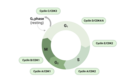 CDKs in cell cycle
 -
 CDK2-Selective inhibitor


