Brodimoprim: Difference between revisions
CSV import Tags: mobile edit mobile web edit |
CSV import Tags: mobile edit mobile web edit |
||
| (One intermediate revision by the same user not shown) | |||
| Line 1: | Line 1: | ||
{{Short description|An article about the antibiotic Brodimoprim}} | |||
== | ==Brodimoprim== | ||
[[File:Brodimoprim_synthesis.svg|thumb|right|Chemical synthesis of Brodimoprim]] | |||
'''Brodimoprim''' is a [[synthetic]] [[antibiotic]] belonging to the class of [[diaminopyrimidines]]. It is structurally related to [[trimethoprim]], another well-known antibiotic, and functions by inhibiting bacterial [[dihydrofolate reductase]], an enzyme critical for the synthesis of [[tetrahydrofolate]], which is necessary for bacterial [[DNA]] synthesis. | |||
Brodimoprim | ==Mechanism of Action== | ||
Brodimoprim acts by selectively inhibiting the bacterial enzyme [[dihydrofolate reductase]]. This enzyme is responsible for the reduction of [[dihydrofolate]] to [[tetrahydrofolate]], a form of [[folic acid]] that is required for the synthesis of [[nucleic acids]] and ultimately for bacterial growth and replication. By inhibiting this enzyme, brodimoprim effectively halts bacterial cell division, leading to the death of the bacteria. | |||
== | ==Clinical Uses== | ||
Brodimoprim is used in the treatment of various bacterial infections, particularly those caused by [[Gram-positive bacteria]]. It is often used in combination with other antibiotics to enhance its efficacy and to prevent the development of [[antibiotic resistance]]. | |||
Brodimoprim is | ==Pharmacokinetics== | ||
Brodimoprim is well absorbed from the [[gastrointestinal tract]] and is widely distributed throughout the body. It is metabolized in the [[liver]] and excreted primarily in the [[urine]]. The drug has a relatively long half-life, which allows for less frequent dosing compared to some other antibiotics. | |||
== Side Effects == | ==Side Effects== | ||
Common side effects of brodimoprim include [[nausea]], [[vomiting]], and [[rash]]. As with other antibiotics, there is a risk of [[allergic reactions]] and [[antibiotic-associated diarrhea]]. | |||
==Synthesis== | |||
The synthesis of brodimoprim involves the chemical modification of the pyrimidine ring to enhance its antibacterial activity. The process is depicted in the accompanying diagram, which shows the step-by-step chemical reactions involved in the synthesis of brodimoprim from its precursor compounds. | |||
== | ==Related pages== | ||
* [[Trimethoprim]] | |||
* [[Antibiotic resistance]] | |||
* [[Dihydrofolate reductase]] | |||
* [[Dihydrofolate reductase | |||
[[Category:Antibiotics]] | [[Category:Antibiotics]] | ||
[[Category: | [[Category:Diaminopyrimidines]] | ||
= Brodimoprim = | |||
<gallery> | |||
File:Brodimoprim.svg|Structure of Brodimoprim | |||
File:Brodimoprim_synthesis.svg|Synthesis of Brodimoprim | |||
</gallery> | |||
Latest revision as of 01:48, 17 February 2025
An article about the antibiotic Brodimoprim
Brodimoprim[edit]

Brodimoprim is a synthetic antibiotic belonging to the class of diaminopyrimidines. It is structurally related to trimethoprim, another well-known antibiotic, and functions by inhibiting bacterial dihydrofolate reductase, an enzyme critical for the synthesis of tetrahydrofolate, which is necessary for bacterial DNA synthesis.
Mechanism of Action[edit]
Brodimoprim acts by selectively inhibiting the bacterial enzyme dihydrofolate reductase. This enzyme is responsible for the reduction of dihydrofolate to tetrahydrofolate, a form of folic acid that is required for the synthesis of nucleic acids and ultimately for bacterial growth and replication. By inhibiting this enzyme, brodimoprim effectively halts bacterial cell division, leading to the death of the bacteria.
Clinical Uses[edit]
Brodimoprim is used in the treatment of various bacterial infections, particularly those caused by Gram-positive bacteria. It is often used in combination with other antibiotics to enhance its efficacy and to prevent the development of antibiotic resistance.
Pharmacokinetics[edit]
Brodimoprim is well absorbed from the gastrointestinal tract and is widely distributed throughout the body. It is metabolized in the liver and excreted primarily in the urine. The drug has a relatively long half-life, which allows for less frequent dosing compared to some other antibiotics.
Side Effects[edit]
Common side effects of brodimoprim include nausea, vomiting, and rash. As with other antibiotics, there is a risk of allergic reactions and antibiotic-associated diarrhea.
Synthesis[edit]
The synthesis of brodimoprim involves the chemical modification of the pyrimidine ring to enhance its antibacterial activity. The process is depicted in the accompanying diagram, which shows the step-by-step chemical reactions involved in the synthesis of brodimoprim from its precursor compounds.
Related pages[edit]
Brodimoprim[edit]
-
 Structure of Brodimoprim
 -
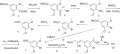 Synthesis of Brodimoprim

