Australian bat lyssavirus: Difference between revisions
CSV import Tags: mobile edit mobile web edit |
CSV import |
||
| Line 23: | Line 23: | ||
{{Virus-stub}} | {{Virus-stub}} | ||
{{Australia-stub}} | {{Australia-stub}} | ||
== Australian_bat_lyssavirus == | |||
<gallery> | |||
File:CSIRO_ScienceImage_1977_Bat_Lyssavirus.jpg|CSIRO Science Image 1977 Bat Lyssavirus | |||
File:Vsv_virion.jpg|Vsv virion | |||
File:Viruses-06-00909-g002-1024.webp|Viruses 06 00909 g002 1024 | |||
File:Distribution-of-ABLV-host-reservoir-species-Adapted-from-12-14.png|Distribution of ABLV host reservoir species Adapted from 12 14 | |||
</gallery> | |||
Latest revision as of 23:49, 24 February 2025
Australian bat lyssavirus (ABL) is a rabies-like virus that can be transmitted to humans, causing serious illness and death. It was first identified in Australia in 1996. ABL is carried by both fruit bats (also known as flying foxes) and insectivorous bats.
Transmission[edit]
ABL is transmitted to humans through bites or scratches from infected bats. It can also be contracted if the virus comes into contact with a person's eyes, nose or mouth, or enters the body through a break in the skin.
Symptoms[edit]
The symptoms of ABL are similar to those of rabies and may include fever, headache, lethargy, agitation, confusion, and difficulty swallowing. As the disease progresses, it can cause paralysis, delirium, convulsions, and death.
Prevention[edit]
Prevention of ABL involves avoiding contact with bats. If a person is bitten or scratched by a bat, immediate treatment with rabies immunoglobulin and a series of rabies vaccine injections can prevent the onset of symptoms and death.
Treatment[edit]
There is no specific treatment for ABL once symptoms have appeared. Treatment involves supportive care and management of symptoms.
See also[edit]


Australian_bat_lyssavirus[edit]
-
 CSIRO Science Image 1977 Bat Lyssavirus
 -
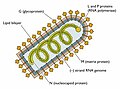 Vsv virion
 -
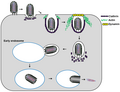 Viruses 06 00909 g002 1024
 -
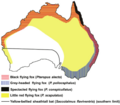 Distribution of ABLV host reservoir species Adapted from 12 14


