Sukkot: Difference between revisions
CSV import Tags: mobile edit mobile web edit |
CSV import |
||
| Line 26: | Line 26: | ||
[[Category:Autumn holidays]] | [[Category:Autumn holidays]] | ||
[[Category:Hebrew words and phrases]] | [[Category:Hebrew words and phrases]] | ||
<gallery> | |||
File:Sukkoth_-_IZE10160.jpg|Sukkot | |||
File:EtrogC.jpg|Etrog | |||
File:Sukkah_Roofs.jpg|Sukkah Roofs | |||
File:Adlib_image_(3).jpg|Sukkot | |||
File:Flickr_-_U.S._Embassy_Tel_Aviv_-_Sukkot2011No.075.jpg|Sukkot | |||
File:Sukkot_Prayer2.jpg|Sukkot Prayer | |||
File:PikiWiki_Israel_14882_Western_Wall_in_Jerusalem.jpg|Western Wall in Jerusalem | |||
File:A_tabernacle_in_a_Jer._(i.e.,_Jerusalem)_Quarter_of_European_Jews._Rehavia,_Mr._Bassam's_flat,_closer_view_LOC_matpc.19885.jpg|Tabernacle in Jerusalem | |||
File:Soukkah_(Sukkah)_fin_du_XIXe_siècle,_Autriche_ou_Sud_de_l'Allemagne_-_Musée_d'art_et_d'histoire_du_Judaïsme.jpg|Sukkah, late 19th century, Austria or Southern Germany | |||
File:Flickr_-_Government_Press_Office_(GPO)_-_Sukkah_in_Abu_Kabir.jpg|Sukkah in Abu Kabir | |||
</gallery> | |||
Latest revision as of 11:53, 18 February 2025
Sukkot (also known as Feast of Booths or Tabernacles) is a significant, week-long Jewish holiday that occurs five days after Yom Kippur. It is one of the three biblically mandated festivals on which Hebrews were commanded to make a pilgrimage to the Temple in Jerusalem.
Etymology[edit]
The Hebrew word "Sukkot" refers to the temporary dwellings that farmers would live in during harvesting, a direct reference to the temporary dwellings in which the Israelites stayed during their 40 years of travel in the desert after the Exodus from slavery in Egypt.
Historical Origin[edit]
According to the Torah, Sukkot commemorates the forty-year period during which the children of Israel were wandering in the desert, living in temporary shelters. Sukkot is therefore a commemoration of the fight for survival in the desert and the final emergence into the Land of Israel.
Observance[edit]
Sukkot is celebrated by a number of activities. The most well-known is the building of the Sukkah, a temporary dwelling in which meals are eaten throughout the festival. Other observances include the waving of the Four Species, as well as additional prayers and meals.
Significance[edit]
Sukkot is considered a joyous festival and is often referred to as Z'man Simchateinu, the Season of our Rejoicing. It is a time to remember the wandering in the desert, but also a time to celebrate the gathering of the harvest and express thanks for the bounty of the earth.
See Also[edit]
| Judaism |
|---|
|
[[File:
   |200px|center|alt=]] |200px|center|alt=]]
|
| Jewish and Israeli holidays and observances | ||||||||
|---|---|---|---|---|---|---|---|---|
|

-
 Sukkot
 -
 Etrog
Etrog -
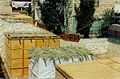 Sukkah Roofs
 -
 Sukkot
 -
 Sukkot
 -
 Sukkot Prayer
 -
 Western Wall in Jerusalem
 -
 Tabernacle in Jerusalem
 -
 Sukkah, late 19th century, Austria or Southern Germany
 -
 Sukkah in Abu Kabir


.jpg)


_Quarter_of_European_Jews._Rehavia,_Mr._Bassam%27s_flat,_closer_view_LOC_matpc.19885.jpg)
_fin_du_XIXe_si%C3%A8cle,_Autriche_ou_Sud_de_l%27Allemagne_-_Mus%C3%A9e_d%27art_et_d%27histoire_du_Juda%C3%AFsme.jpg)
_-_Sukkah_in_Abu_Kabir.jpg)
