Jostaberry: Difference between revisions
CSV import Tags: mobile edit mobile web edit |
CSV import |
||
| Line 26: | Line 26: | ||
[[Category:Hybrid plants]] | [[Category:Hybrid plants]] | ||
{{food-stub}} | {{food-stub}} | ||
<gallery> | |||
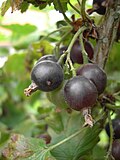
File:Ribes nidigrolaria.jpg|Jostaberry | |||
</gallery> | |||
Latest revision as of 01:38, 20 February 2025
Jostaberry is a complex-cross fruit bush in the Ribes family, which is inclusive of currants and gooseberries. The name is a combination of the German words for blackcurrant and gooseberry, "Johannisbeere" and "Stachelbeere" respectively.
History[edit]
The Jostaberry was first cultivated in the 1970s by the Institute for Breeding Research on Horticultural and Fruit Crops in Dresden, Germany. It was bred as a hybrid of the black currant (Ribes nigrum) and the North American coastal black gooseberry (Ribes divaricatum).
Description[edit]
The Jostaberry bush is larger than both the currant and gooseberry bushes, reaching heights of up to 2 meters. The fruit itself is larger than a currant but smaller than most gooseberries; it is black in color and has a unique, sweet-tart flavor. The Jostaberry is thornless, a characteristic inherited from its blackcurrant parent.
Cultivation[edit]
Jostaberries are hardy plants that can tolerate a variety of soil conditions, though they prefer well-drained, slightly acidic soil. They are resistant to many common pests and diseases that affect other Ribes species, including American gooseberry mildew and blackcurrant gall mite.
Uses[edit]
Jostaberries can be eaten fresh or used in cooking and baking. They are often used in jams, jellies, desserts, and wines due to their unique flavor and high pectin content. They are also high in vitamin C and other antioxidants, making them a nutritious addition to the diet.
See also[edit]

-
 Jostaberry

