Penicillium digitatum: Difference between revisions
CSV import Tags: mobile edit mobile web edit |
CSV import |
||
| Line 24: | Line 24: | ||
{{Plant-pathogen-stub}} | {{Plant-pathogen-stub}} | ||
{{food-stub}} | {{food-stub}} | ||
<gallery> | |||
File:Penicillium_digitatum_orange.jpg|Penicillium digitatum on orange | |||
File:Penicillium_digitatum_plate.png|Penicillium digitatum on culture plate | |||
</gallery> | |||
Latest revision as of 01:35, 18 February 2025
Penicillium digitatum is a fungus species of the genus Penicillium, which is known to cause postharvest diseases in many fruits, particularly citrus fruits. It is the most common pathogen causing the disease known as green mold, which is a significant postharvest issue for citrus industries worldwide.
Taxonomy[edit]
Penicillium digitatum belongs to the Fungal kingdom, specifically within the Ascomycota phylum. It is part of the Eurotiomycetes class, which includes a variety of molds. Within this class, it falls under the order Eurotiales, and the family Trichocomaceae. The genus is Penicillium, which includes over 300 species.
Morphology[edit]
Penicillium digitatum is characterized by its brush-like conidiophores, which are structures that bear conidia or asexual spores. The conidia are typically green, giving the mold its characteristic color. The fungus grows rapidly, producing a dense mycelium that can completely cover the infected fruit.
Pathogenicity[edit]
Penicillium digitatum is a necrotrophic fungus, meaning it kills host tissue and then feeds on the dead material. It primarily affects citrus fruits, causing a disease known as green mold. The fungus enters the fruit through wounds or natural openings and then rapidly colonizes the fruit tissue, causing it to rot. The disease can cause significant economic losses in citrus industries.
Control[edit]
Control of Penicillium digitatum is primarily achieved through the use of fungicides. However, the fungus has shown increasing resistance to many commonly used fungicides, making control more difficult. Other control methods include the use of biocontrol agents, such as other fungi or bacteria that can inhibit the growth of P. digitatum, and postharvest treatments such as heat treatment or UV irradiation.
See also[edit]

| This article is a stub. You can help WikiMD by registering to expand it. |

-
 Penicillium digitatum on orange
 -
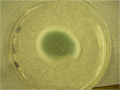 Penicillium digitatum on culture plate


