Rosellinia subiculata: Difference between revisions
CSV import |
CSV import |
||
| Line 35: | Line 35: | ||
[[Category:Xylariaceae]] | [[Category:Xylariaceae]] | ||
{{fungus-stub}} | {{fungus-stub}} | ||
== Rosellinia subiculata gallery == | |||
<gallery> | |||
File:Rosellinia subiculata 58489156.jpg|Rosellinia subiculata | |||
</gallery> | |||
Latest revision as of 06:09, 3 March 2025
Rosellinia subiculata is a species of fungus in the family Xylariaceae. It is a type of Ascomycota, which is a division of fungi that produces spores inside special, elongated cells or sacs, known as asci.
Taxonomy[edit]
The species was first described scientifically by the mycologist Piero Saccardo in 1882. The genus name Rosellinia is in honor of the Spanish mycologist Carlos Luis Spegazzini, while the species epithet subiculata refers to the characteristic shape of the fruiting bodies.
Description[edit]
Rosellinia subiculata is characterized by its small, black, and hard fruiting bodies, known as perithecia. These are typically embedded in the substrate, with only the necks protruding. The perithecia are flask-shaped, with a narrow neck that opens to the outside. The spores are elliptical, dark brown, and have a smooth surface.
Distribution and habitat[edit]
Rosellinia subiculata is found in various parts of the world, including North America, Europe, and Asia. It is a saprophytic fungus, meaning it feeds on dead or decaying organic matter. It is commonly found on decaying wood and plant debris.
Ecology[edit]
As a saprophyte, Rosellinia subiculata plays a crucial role in nutrient cycling in ecosystems. By decomposing organic matter, it helps to return nutrients to the soil, which can then be used by plants and other organisms.
See also[edit]
References[edit]
<references group="" responsive="1"></references>
External links[edit]

Rosellinia subiculata gallery[edit]
-
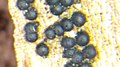 Rosellinia subiculata

