Rhizoctonia solani: Difference between revisions
CSV import |
CSV import |
||
| Line 23: | Line 23: | ||
{{Fungi-stub}} | {{Fungi-stub}} | ||
{{Plant-pathogen-stub}} | {{Plant-pathogen-stub}} | ||
== Rhizoctonia solani == | |||
<gallery> | |||
File:Rhizoctonia_hyphae_160X.png|Rhizoctonia hyphae 160X | |||
File:Rhizoctonia_solani_symptoms_beet.jpg|Rhizoctonia solani symptoms on beet | |||
File:Rhizoctonia_solani_symptoms_on_bean_roots.jpg|Rhizoctonia solani symptoms on bean roots | |||
File:Rhizoctonia_solani.jpg|Rhizoctonia solani | |||
</gallery> | |||
Latest revision as of 21:01, 25 February 2025
Rhizoctonia solani is a soil-borne fungus that is known to cause various plant diseases. It is a member of the Basidiomycota phylum and belongs to the order Cantharellales. The fungus is a complex species and is divided into several anastomosis groups (AGs) based on hyphal anastomosis reactions.
Taxonomy[edit]
The taxonomy of Rhizoctonia solani has been a subject of debate among mycologists. It is currently classified under the phylum Basidiomycota, class Agaricomycetes, and order Cantharellales. The fungus does not produce a sexual stage in its life cycle, which is a characteristic of the imperfect fungi.
Morphology[edit]
Rhizoctonia solani is characterized by its brown, septate hyphae that are typically 7-10 µm in diameter. The fungus forms a dense mycelium that can produce sclerotia, which are compact masses of hardened mycelium that serve as survival structures.
Pathogenicity[edit]
Rhizoctonia solani is a necrotrophic pathogen that causes disease in a wide range of plant hosts. The fungus is known to cause diseases such as damping off, root rot, and wire stem in crops like potato, rice, cotton, and soybean. The pathogenicity of R. solani is determined by its AG, with different AGs causing specific diseases in certain host plants.
Management[edit]
Management of Rhizoctonia solani involves a combination of cultural practices, biological control, and chemical control. Cultural practices include crop rotation and sanitation to reduce the inoculum in the soil. Biological control involves the use of antagonistic organisms like Trichoderma spp. and Bacillus spp. Chemical control includes the use of fungicides like iprodione and penthiopyrad.
See also[edit]

| This article is a stub. You can help WikiMD by registering to expand it. |
Rhizoctonia solani[edit]
-
 Rhizoctonia hyphae 160X
 -
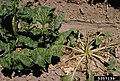 Rhizoctonia solani symptoms on beet
 -
 Rhizoctonia solani symptoms on bean roots
 -
 Rhizoctonia solani


