Pseudomonas syringae: Difference between revisions
CSV import |
CSV import |
||
| Line 26: | Line 26: | ||
{{Bacteria-stub}} | {{Bacteria-stub}} | ||
{{Plant-pathogen-stub}} | {{Plant-pathogen-stub}} | ||
<gallery> | |||
File:Pseudomonas_syringae_cultures.jpg|Pseudomonas syringae cultures | |||
File:Smart-tomato-speck.JPG|Tomato speck caused by Pseudomonas syringae | |||
File:Collmer_leaf_speck3.jpg|Leaf speck caused by Pseudomonas syringae | |||
</gallery> | |||
Latest revision as of 02:04, 18 February 2025
Pseudomonas syringae is a rod-shaped, Gram-negative bacterium that is commonly found in the environment. It is a plant pathogen, causing diseases in a wide range of plant species.
Taxonomy[edit]
The genus Pseudomonas is a diverse group of bacteria, and Pseudomonas syringae is one of the most well-studied species within this group. It is further divided into over 60 pathovars, each of which is associated with a specific set of host plants.
Morphology[edit]
Pseudomonas syringae is a rod-shaped bacterium, typical of the Pseudomonas genus. It is Gram-negative, meaning it does not retain the crystal violet stain used in the Gram stain procedure.
Pathogenicity[edit]
Pseudomonas syringae is a plant pathogen, causing diseases in a wide range of plant species. It is best known for causing bacterial canker in kiwifruit, but it can also infect other fruit trees, vegetables, and ornamental plants. The bacterium enters the plant through natural openings or wounds, and then multiplies in the intercellular spaces.
Ice nucleation[edit]
Pseudomonas syringae is also notable for its ability to cause water to freeze at relatively high temperatures, a phenomenon known as ice nucleation. This can cause frost damage to plants, but it also has potential applications in artificial snow production and in cloud seeding.
Control[edit]
Control of Pseudomonas syringae is challenging due to its wide host range and environmental persistence. However, various strategies can be used, including the use of resistant plant varieties, good agricultural practices, and in some cases, chemical treatments.
See also[edit]

| This article is a stub. You can help WikiMD by registering to expand it. |
-
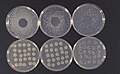 Pseudomonas syringae cultures
 -
 Tomato speck caused by Pseudomonas syringae
 -
 Leaf speck caused by Pseudomonas syringae


