House cricket: Difference between revisions
CSV import |
CSV import Tags: mobile edit mobile web edit |
||
| Line 30: | Line 30: | ||
{{Insect-stub}} | {{Insect-stub}} | ||
{{food-stub}} | {{food-stub}} | ||
== House_cricket == | |||
<gallery> | |||
File:Acheta_domesticus,_adultes_Weibchen.jpg|Acheta domesticus, adult female | |||
File:Chingrit_thot.jpg|Chingrit thot | |||
</gallery> | |||
Latest revision as of 11:27, 25 February 2025
House Cricket (Acheta domesticus) is a species of cricket that is commonly found in residential areas around the world.
Description[edit]
The House Cricket is typically light yellowish-brown in color and measures approximately 16-21 millimeters in length. It has long, slender antennae and a distinctive chirping sound, which is produced by the rubbing together of the forewings.
Habitat[edit]
House Crickets are native to Southwest Asia, but have spread worldwide. They are commonly found in warm environments, such as inside houses and in rubbish dumps. They are nocturnal creatures and are most active during the night.
Diet[edit]
House Crickets are omnivorous and feed on a variety of food sources. They are known to eat plant material, dead or weakened insects, and even their own kind when food is scarce.
Life Cycle[edit]
The life cycle of the House Cricket consists of three stages: egg, nymph, and adult. The female cricket lays her eggs in damp soil or inside houses. The eggs hatch into nymphs, which resemble small adults. The nymphs undergo several molts before reaching adulthood.
In Culture[edit]
In some cultures, House Crickets are kept as pets or for their song. In others, they are considered pests due to their tendency to eat fabric and foodstuffs.
Control[edit]
Control of House Crickets typically involves reducing potential hiding places and food sources. Insecticides are also commonly used.
See Also[edit]


House_cricket[edit]
-
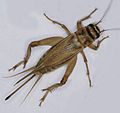 Acheta domesticus, adult female
 -
 Chingrit thot


