Sugar sculpture: Difference between revisions
CSV import Tags: mobile edit mobile web edit |
CSV import |
||
| Line 27: | Line 27: | ||
[[Category:Food art]] | [[Category:Food art]] | ||
{{food-stub}} | {{food-stub}} | ||
<gallery> | |||
File:Pulled_sugar_roses.jpg|Pulled sugar roses | |||
File:Zuckerplastik_zur_Freiheitsidee_1880_Zucker-Museum.jpg|Zuckerplastik zur Freiheitsidee, 1880, Zucker-Museum | |||
File:Trionfi_di_Cibele_e_Juno.jpg|Trionfi di Cibele e Juno | |||
File:Sèvres_-_Moulage-reparage_-_pastillage_27.jpg|Sèvres - Moulage-reparage - pastillage | |||
File:Alinea_-_COURSE_24.jpg|Alinea - COURSE 24 | |||
File:The_Ameya_by_Robert_Frederick_Blum.jpg|The Ameya by Robert Frederick Blum | |||
</gallery> | |||
Latest revision as of 10:54, 18 February 2025
Sugar sculpture is the art of producing artistic centerpieces entirely composed of sugar and sugar derivatives. These sculptures, often found in forms of cake decorations and showpieces, are traditionally used in professional pastry competitions as well as in the pastry and baking industry.
History[edit]
Sugar sculpture originated in the Middle Ages in Europe, where it was a luxury afforded only by the wealthy. The art form was brought to new heights in the Renaissance and Baroque periods, where it was used to create elaborate table centerpieces for banquets.
Techniques[edit]
There are several techniques used in sugar sculpture, including pulled sugar, blown sugar, and cast sugar. Pulled sugar is made by boiling sugar to a certain temperature and then, once cooled, pulling it into a variety of shapes. Blown sugar is a similar process, but involves blowing air into the sugar as it cools to create hollow shapes. Cast sugar involves pouring the boiled sugar into molds to create solid shapes.
Materials[edit]
The primary material used in sugar sculpture is sucrose, although glucose and isomalt are also commonly used. These sugars are often colored using food coloring to create a variety of effects.
Notable sugar artists[edit]
There are many notable sugar artists who have made significant contributions to the field. These include Ewald Notter, known as one of the world's foremost experts in sugar sculpture, and Jacquy Pfeiffer, co-founder of the French Pastry School in Chicago.
See also[edit]

-
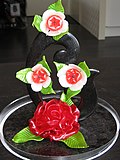 Pulled sugar roses
 -
 Zuckerplastik zur Freiheitsidee, 1880, Zucker-Museum
 -
 Trionfi di Cibele e Juno
 -
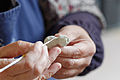 Sèvres - Moulage-reparage - pastillage
 -
 Alinea - COURSE 24
 -
 The Ameya by Robert Frederick Blum


