Tsokolate: Difference between revisions
CSV import Tags: mobile edit mobile web edit |
CSV import |
||
| (One intermediate revision by the same user not shown) | |||
| Line 1: | Line 1: | ||
== Tsokolate == | |||
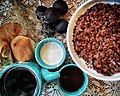
[[File:Sikwate.jpg|thumb|A cup of tsokolate]] | |||
[[File:Tablea-_The_Pinoy_Chocolate.jpg|thumb|Tablea used for making tsokolate]] | |||
[[File:Dumaguete_Sta_Monica_Beach_Club_-_Suman_Mangga_Tsokolate_2.jpg|thumb|Tsokolate served with suman and mango]] | |||
[[File:Tsokolate_de_Ylocos_Cacao_Tablea1.jpg|thumb|Cacao tablea from Ilocos]] | |||
'''Tsokolate''' is a traditional Filipino hot chocolate drink made from [[cacao]] beans. It is a popular beverage in the [[Philippines]], especially during breakfast or merienda (afternoon snack). The drink is known for its rich and thick consistency, which is achieved by using pure cacao tablets known as "[[tablea]]". | |||
== Preparation == | == Preparation == | ||
Tsokolate is | Tsokolate is prepared by dissolving tablea in hot water or milk. The mixture is then whisked using a traditional wooden whisk called a "[[batirol]]" until it becomes frothy. The resulting drink is thick and creamy, with a strong chocolate flavor. Sugar is often added to taste, and some variations include the addition of [[condensed milk]] or [[evaporated milk]] for extra creaminess. | ||
== | == Cultural Significance == | ||
In Filipino culture, tsokolate is more than just a beverage; it is a symbol of hospitality and warmth. It is often served to guests and is a staple during family gatherings and celebrations. The drink is also associated with [[Christmas]] and other festive occasions, where it is enjoyed alongside traditional Filipino sweets such as [[suman]] (rice cakes) and [[puto]] (steamed rice cakes). | |||
== | == Variations == | ||
There are several regional variations of tsokolate in the Philippines. In [[Batangas]], a province known for its cacao production, the drink is called "sikwate" and is made with locally sourced tablea. In [[Bicol]], a spicy version known as "tsokolate eh" is popular, which includes a hint of chili pepper for added heat. | |||
== Related Pages == | |||
* [[Cacao]] | |||
* [[ | * [[Tablea]] | ||
* [[ | |||
* [[Batirol]] | * [[Batirol]] | ||
* [[Philippine cuisine]] | |||
== References == | |||
* "Philippine Chocolate: A History of Cacao in the Philippines." Retrieved from [https://www.example.com/philippine-chocolate-history]. | |||
* "The Art of Making Tsokolate." Retrieved from [https://www.example.com/art-of-tsokolate]. | |||
[[Category: | [[Category:Philippine cuisine]] | ||
[[Category:Chocolate drinks]] | [[Category:Chocolate drinks]] | ||
<gallery> | |||
File:Sikwate.jpg|Tsokolate | |||
File:Tablea-_The_Pinoy_Chocolate.jpg|Tsokolate | |||
File:Dumaguete_Sta_Monica_Beach_Club_-_Suman_Mangga_Tsokolate_2.jpg|Tsokolate | |||
File:Tsokolate_de_Ylocos_Cacao_Tablea1.jpg|Tsokolate | |||
</gallery> | |||
Latest revision as of 04:39, 18 February 2025
Tsokolate[edit]


Tsokolate is a traditional Filipino hot chocolate drink made from cacao beans. It is a popular beverage in the Philippines, especially during breakfast or merienda (afternoon snack). The drink is known for its rich and thick consistency, which is achieved by using pure cacao tablets known as "tablea".
Preparation[edit]
Tsokolate is prepared by dissolving tablea in hot water or milk. The mixture is then whisked using a traditional wooden whisk called a "batirol" until it becomes frothy. The resulting drink is thick and creamy, with a strong chocolate flavor. Sugar is often added to taste, and some variations include the addition of condensed milk or evaporated milk for extra creaminess.
Cultural Significance[edit]
In Filipino culture, tsokolate is more than just a beverage; it is a symbol of hospitality and warmth. It is often served to guests and is a staple during family gatherings and celebrations. The drink is also associated with Christmas and other festive occasions, where it is enjoyed alongside traditional Filipino sweets such as suman (rice cakes) and puto (steamed rice cakes).
Variations[edit]
There are several regional variations of tsokolate in the Philippines. In Batangas, a province known for its cacao production, the drink is called "sikwate" and is made with locally sourced tablea. In Bicol, a spicy version known as "tsokolate eh" is popular, which includes a hint of chili pepper for added heat.
Related Pages[edit]
References[edit]
- "Philippine Chocolate: A History of Cacao in the Philippines." Retrieved from [1].
- "The Art of Making Tsokolate." Retrieved from [2].
-
 Tsokolate
 -
 Tsokolate
 -
 Tsokolate
 -
 Tsokolate
