Yong tau foo: Difference between revisions
CSV import |
CSV import Tags: mobile edit mobile web edit |
||
| Line 27: | Line 27: | ||
{{Chinese-food-stub}} | {{Chinese-food-stub}} | ||
{{food-stub}} | {{food-stub}} | ||
<gallery> | |||
File:Hakka_yong_tau_foo_with_noodles.jpg|Hakka yong tau foo with noodles | |||
File:Hakka_yong_tau_foo.jpg|Hakka yong tau foo | |||
File:Yong_tau_foo_buffet_style.jpg|Yong tau foo buffet style | |||
File:2019_01_Yen_tafo.jpg|Yong tau foo | |||
</gallery> | |||
Latest revision as of 04:34, 18 February 2025
Yong Tau Foo is a popular Chinese dish commonly found in China, Malaysia, Singapore, and Thailand. The name Yong Tau Foo translates to "stuffed bean curd", although the dish encompasses a variety of stuffed vegetables and tofu.
History[edit]
The dish originated from the Hakka people in China. The Hakka people are known for their unique culinary traditions, and Yong Tau Foo is one of their most famous dishes. The dish was brought to Southeast Asia by Chinese immigrants and has since become a staple in the local cuisines of Malaysia, Singapore, and Thailand.
Preparation[edit]
Yong Tau Foo is prepared by stuffing pieces of tofu and vegetables with a paste made from fish or pork. The stuffed items are then cooked in a broth. The dish can be served with rice or noodles, and is often accompanied by a dipping sauce made from chili and soy sauce.
Variations[edit]
There are many variations of Yong Tau Foo, depending on the region. In Malaysia and Singapore, the dish is often served in a laksa broth, while in Thailand, it is commonly served in a clear soup. In China, the dish is typically served with a spicy sauce.
Cultural Significance[edit]
Yong Tau Foo is not just a dish, but also a cultural symbol. It represents the Hakka people's ingenuity and resourcefulness, as they were able to create a delicious and nutritious dish using simple and readily available ingredients.
See Also[edit]

-
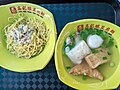 Hakka yong tau foo with noodles
 -
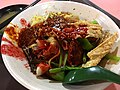 Hakka yong tau foo
 -
 Yong tau foo buffet style
 -
 Yong tau foo


