Philippine adobo: Difference between revisions
CSV import |
CSV import |
||
| Line 26: | Line 26: | ||
{{Philippine-cuisine-stub}} | {{Philippine-cuisine-stub}} | ||
{{food-stub}} | {{food-stub}} | ||
<gallery> | |||
File:Adobo_DSCF4391.jpg|Adobo DSCF4391 | |||
File:Chicken_Adobo_over_rice.jpg|Chicken Adobo over rice | |||
File:Chicken_adobo_(Philippines)_2.jpg|Chicken adobo (Philippines) 2 | |||
File:Pork_adobo_with_shallots.jpg|Pork adobo with shallots | |||
File:Adobong_sitaw_(green_beans_and_pork)_-_Philippines_02.jpg|Adobong sitaw (green beans and pork) - Philippines 02 | |||
File:Fely_J's_Adobo.jpg|Fely J's Adobo | |||
File:Filipino_Chicken_Adobo.JPG|Filipino Chicken Adobo | |||
File:Chicken_Adobo_with_Coconut_Milk.jpg|Chicken Adobo with Coconut Milk | |||
</gallery> | |||
Latest revision as of 11:47, 25 February 2025
Philippine adobo is a popular dish and cooking process in Philippine cuisine that involves meat, seafood, or vegetables marinated in vinegar, soy sauce, garlic, and spices. The term "adobo" is derived from the Spanish word "adobar," meaning marinade or pickling sauce. Despite the name, Philippine adobo is indigenous to the Philippines and has a flavor profile and cooking method distinct from Spanish adobo.
History[edit]
The cooking method used in Philippine adobo predates the arrival of the Spanish in the Philippines in the 16th century. Early Filipinos cooked their food with vinegar and salt to keep it from spoiling in the tropical climate. When the Spanish colonizers encountered this cooking process, they referred to it as "adobo" due to its slight similarity to the Spanish adobo.
Ingredients and Preparation[edit]
The primary ingredients of Philippine adobo are protein (usually chicken, pork, or a combination of both), vinegar, soy sauce, garlic, bay leaves, and black peppercorns. Variations of the dish may include other ingredients such as potatoes, hard-boiled eggs, or pineapple chunks.
The meat is marinated in the vinegar, soy sauce, and garlic mixture for several hours or overnight. It is then simmered in the marinade until tender. The sauce is reduced and thickened to a consistency that coats the meat. The dish is typically served with white rice.
Variations[edit]
There are numerous regional variations of Philippine adobo, each with unique ingredients and preparation methods. Some of these include adobong puti (white adobo), which uses salt instead of soy sauce, and adobong dilaw (yellow adobo), which includes turmeric. Other variations may use coconut milk, annatto seeds, or even include seafood like squid or catfish.
Cultural Significance[edit]
Philippine adobo is considered the unofficial national dish of the Philippines. It is a staple in Filipino households and is commonly served at gatherings and fiestas. The dish's versatility and long shelf-life have contributed to its popularity and widespread availability.
See Also[edit]


-
 Adobo DSCF4391
 -
 Chicken Adobo over rice
 -
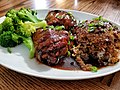 Chicken adobo (Philippines) 2
 -
 Pork adobo with shallots
 -
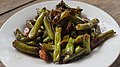 Adobong sitaw (green beans and pork) - Philippines 02
 -
 Fely J's Adobo
 -
 Filipino Chicken Adobo
 -
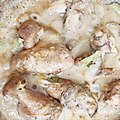 Chicken Adobo with Coconut Milk


_2.jpg)

_-_Philippines_02.jpg)


