Pangolin trade: Difference between revisions
CSV import Tags: mobile edit mobile web edit |
CSV import |
||
| Line 33: | Line 33: | ||
{{Conservation biology}} | {{Conservation biology}} | ||
{{food-stub}} | {{food-stub}} | ||
<gallery> | |||
File:Zoo_Leipzig_-_Tou_Feng.jpg|Pangolin in Zoo Leipzig | |||
File:Manis_ranges.png|Range map of pangolin species | |||
File:Coat_of_Pangolin_scales.JPG|Coat made of pangolin scales | |||
File:Myanmar_Illicit_Endangered_Wildlife_Market_04_(cropped).jpg|Pangolin scales in Myanmar wildlife market | |||
File:Pangolin_du_Cameroun_03.jpg|Pangolin in Cameroon | |||
File:Pangolin_scale_burn_in_Cameroon._Credit-_Kenneth_Cameron_-_USFWS_(2)_(32575640450).jpg|Pangolin scale burn in Cameroon | |||
File:Pangolin_scale_burn_in_Cameroon._Credit-_Kenneth_Cameron_-_USFWS_(1)_(32575641040).jpg|Pangolin scale burn in Cameroon | |||
File:Weston_Library_Opening_by_John_Cairns_20.3.15-139_David_Attenborough.jpg|David Attenborough at Weston Library opening | |||
</gallery> | |||
Latest revision as of 12:03, 18 February 2025
Pangolin Trade
The Pangolin Trade refers to the illegal trafficking and trade of pangolins, a group of unique mammals known for their scaly skin and long tongues. Pangolins are the most trafficked mammals in the world, primarily due to the high demand for their scales and meat in certain parts of Asia and Africa.
Overview[edit]
Pangolins are hunted and traded for various reasons. Their meat is considered a delicacy in some cultures, while their scales are used in traditional Chinese medicine. The trade is driven by high demand and high profits, with pangolin scales fetching a high price on the black market.
Impact on Pangolin Populations[edit]
The pangolin trade has had a devastating impact on pangolin populations worldwide. All eight species of pangolins are now threatened with extinction, according to the International Union for Conservation of Nature (IUCN). The trade is also a significant threat to biodiversity, as pangolins play a crucial role in their ecosystems by controlling insect populations.
Legal Status and Protection[edit]
International trade in pangolins is banned under the Convention on International Trade in Endangered Species of Wild Fauna and Flora (CITES). Despite this, illegal trade continues to thrive due to weak law enforcement and high profits.
Efforts to Combat the Trade[edit]
Various organizations and governments are working to combat the pangolin trade. These efforts include strengthening law enforcement, raising public awareness, and promoting alternative sources of income for communities involved in the trade.
See Also[edit]
| Wildlife trafficking | ||||||||||
|---|---|---|---|---|---|---|---|---|---|---|
This wildlife trafficking related article is a stub.
|

-
 Pangolin in Zoo Leipzig
 -
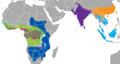 Range map of pangolin species
 -
 Coat made of pangolin scales
 -
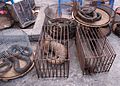 Pangolin scales in Myanmar wildlife market
 -
 Pangolin in Cameroon
 -
 Pangolin scale burn in Cameroon
 -
 Pangolin scale burn in Cameroon
 -
 David Attenborough at Weston Library opening


.jpg)

_(32575640450).jpg)
_(32575641040).jpg)

