Melba (apple): Difference between revisions
CSV import Tags: mobile edit mobile web edit |
CSV import |
||
| Line 29: | Line 29: | ||
[[Category:1898 introductions]] | [[Category:1898 introductions]] | ||
[[Category:Food and drink in Canada]] | [[Category:Food and drink in Canada]] | ||
<gallery> | |||
File:Cross_section_of_Melba,_National_Fruit_Collection_(acc._1925-021).jpg|Cross section of Melba | |||
File:Pomological_Watercolor_POM00002873.jpg|Pomological Watercolor | |||
File:Melba_on_tree,_National_Fruit_Collection_(acc._1925-021).jpg|Melba on tree | |||
</gallery> | |||
Latest revision as of 21:35, 20 February 2025
Melba (apple)
The Melba apple is a cultivar of apple which was introduced in 1898 by the Canadian horticulturist Charles E. Saunders. It was named in honor of the Australian opera singer Dame Nellie Melba.
History[edit]
The Melba apple was first cultivated in the Dominion Experimental Farms system, which was established in 1886 to support the development of farming in Canada. The apple was introduced to the public in 1898 and quickly gained popularity due to its early ripening and excellent flavor.
Characteristics[edit]
The Melba apple is medium-sized with a round shape. The skin is thin and smooth, with a pale yellow background overlaid with a red or pink blush. The flesh is white, crisp, and juicy, with a sweet-tart flavor that is often described as honeyed. The apple is known for its excellent eating quality and is also good for cooking and baking.
Cultivation[edit]
Melba apples are best grown in temperate climates, as they require a cold period in the winter to produce fruit. They are also susceptible to a number of apple diseases, including apple scab and fire blight, so careful management is required to maintain a healthy orchard.
See also[edit]
References[edit]
<references />

-
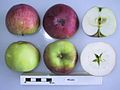 Cross section of Melba
 -
 Pomological Watercolor
 -
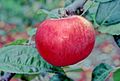 Melba on tree
.jpg)

.jpg)
