Douhua: Difference between revisions
CSV import Tags: mobile edit mobile web edit |
CSV import |
||
| Line 31: | Line 31: | ||
{{Chinese-food-stub}} | {{Chinese-food-stub}} | ||
{{food-stub}} | {{food-stub}} | ||
<gallery> | |||
File:David_enjoying_Dòuhuā.jpg|David enjoying Dòuhuā | |||
File:豆腐花1.jpg|豆腐花 | |||
File:Doufunao_at_Xixinlitun_Breakfast_(20220324073656).jpg|Doufunao at Xixinlitun Breakfast | |||
File:Tofu_brains_doufunao.jpg|Tofu brains doufunao | |||
File:Douhua_dessert.jpg|Douhua dessert | |||
File:豆花+芋圆+珍珠+芋泥.jpg|豆花 with taro balls, pearls, and taro paste | |||
File:Taho2.jpg|Taho | |||
File:Tahwa.jpg|Tahwa | |||
File:Tào_phớ.jpg|Tào phớ | |||
File:Soft_tofu_vendor.jpg|Soft tofu vendor | |||
</gallery> | |||
Latest revision as of 11:25, 18 February 2025
Douhua (also known as tofu pudding or tofu brains) is a traditional Chinese dessert made from very soft tofu. It is also referred to as tofu hua or tau huay in some regions.
History[edit]
The origins of Douhua are traced back to the Han Dynasty (206 BC–220 AD). It is believed to have been discovered by Liu An, a Chinese prince. However, some historical records and legends suggest that Douhua could have been enjoyed even before the Han Dynasty.
Preparation[edit]
Douhua is made by coagulating soy milk until it achieves a soft, silky texture. The coagulation process is typically achieved using a coagulant such as gypsum or nigari. The resulting product is a delicate, pudding-like tofu that can be eaten with a spoon.
Varieties[edit]
There are many regional variations of Douhua throughout China and other parts of Asia. In Northern China, Douhua is often served with soy sauce, making it a savory dish. In contrast, Southern China and Taiwan typically serve Douhua with sweet toppings like sugar syrup or sweet red beans.
In other parts of Asia, such as Malaysia and Singapore, Douhua is commonly served with a sweet syrup infused with ginger or pandan leaves. In the Philippines, a similar dessert known as taho is popular. Taho is served with a sweet syrup and sago pearls.
Cultural Significance[edit]
Douhua is not only a popular dessert but also holds cultural significance in many parts of Asia. It is often consumed during breakfast or as a late-night snack. In Taiwan, Douhua is a common street food and is often sold by vendors in night markets.
See Also[edit]

-
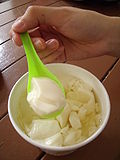 David enjoying Dòuhuā
 -
 豆腐花
豆腐花 -
 Doufunao at Xixinlitun Breakfast
 -
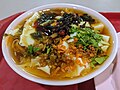 Tofu brains doufunao
 -
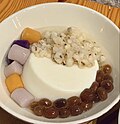 Douhua dessert
 -
 豆花 with taro balls, pearls, and taro paste
 -
 Taho
Taho -
 Tahwa
Tahwa -
 Tào phớ
 -
Soft tofu vendor


.jpg)


