Kamayan: Difference between revisions
CSV import |
CSV import Tags: mobile edit mobile web edit |
||
| (2 intermediate revisions by the same user not shown) | |||
| Line 1: | Line 1: | ||
{{Short description|Traditional Filipino method of eating with hands}} | |||
'''Kamayan''' is a traditional Filipino method of eating that involves using one's hands instead of utensils. This practice is deeply rooted in Filipino culture and is often associated with communal meals and celebrations. The term "kamayan" comes from the Filipino word "kamay," which means "hand." | |||
== | ==History and Cultural Significance== | ||
Kamayan has been a part of Filipino dining customs for centuries. It is believed to have originated from the indigenous peoples of the Philippines, who used their hands to eat long before the introduction of utensils by foreign colonizers. The practice is not only a way of eating but also a cultural expression that emphasizes community, sharing, and connection with food. | |||
In traditional [[Filipino cuisine]], meals are often served on banana leaves, which act as natural plates. This method of serving and eating is particularly common during [[fiestas]], family gatherings, and other social events. Kamayan is seen as a way to bring people together, fostering a sense of unity and camaraderie. | |||
[[ | |||
== | ==Method of Eating== | ||
In | In a kamayan meal, food is typically spread out on banana leaves laid over a table. Dishes such as [[lechon]], [[grilled fish]], [[adobo]], and various [[vegetables]] are arranged in a communal style. Diners use their hands to pick up the food, often mixing rice with other dishes to create a balanced bite. | ||
== | The technique involves using the fingers to gather a small amount of food, pressing it into a compact shape, and then using the thumb to push the food into the mouth. This method allows diners to experience the texture and temperature of the food more intimately than when using utensils. | ||
==Modern Adaptations== | |||
While kamayan remains a traditional practice, it has also been adapted in modern settings. Many Filipino restaurants, both in the Philippines and abroad, offer kamayan-style dining experiences. These establishments often provide diners with the option to eat with their hands, sometimes offering gloves for hygiene purposes. | |||
Kamayan has gained popularity outside the Philippines as well, with many non-Filipinos embracing the practice as a unique and immersive cultural experience. It is often featured in food festivals and cultural events, showcasing the rich culinary heritage of the Philippines. | |||
==Health and Hygiene Considerations== | |||
While kamayan is a cherished tradition, it is important to consider hygiene when eating with hands. Washing hands thoroughly before and after meals is essential to prevent the spread of germs. In communal settings, diners are encouraged to be mindful of others and maintain cleanliness throughout the meal. | |||
==Related Pages== | |||
* [[Filipino cuisine]] | * [[Filipino cuisine]] | ||
* [[ | * [[Lechon]] | ||
* [[ | * [[Adobo]] | ||
* [[Fiesta]] | |||
* [[Banana leaf]] | |||
[[Category: | [[Category:Filipino culture]] | ||
[[Category: | [[Category:Dining etiquette]] | ||
[[Category: | [[Category:Philippine cuisine]] | ||
== Kamayan == | |||
<gallery> | |||
File:Boodle_fight_(kamayan)_02.jpg|Boodle fight (kamayan) 02 | |||
File:Boodle_Fight_(Baler,_Aurora).jpg|Boodle Fight (Baler, Aurora) | |||
File:Boodle_fight.jpg|Boodle fight | |||
</gallery> | |||
Latest revision as of 11:55, 25 February 2025
Traditional Filipino method of eating with hands
Kamayan is a traditional Filipino method of eating that involves using one's hands instead of utensils. This practice is deeply rooted in Filipino culture and is often associated with communal meals and celebrations. The term "kamayan" comes from the Filipino word "kamay," which means "hand."
History and Cultural Significance[edit]
Kamayan has been a part of Filipino dining customs for centuries. It is believed to have originated from the indigenous peoples of the Philippines, who used their hands to eat long before the introduction of utensils by foreign colonizers. The practice is not only a way of eating but also a cultural expression that emphasizes community, sharing, and connection with food.
In traditional Filipino cuisine, meals are often served on banana leaves, which act as natural plates. This method of serving and eating is particularly common during fiestas, family gatherings, and other social events. Kamayan is seen as a way to bring people together, fostering a sense of unity and camaraderie.
Method of Eating[edit]
In a kamayan meal, food is typically spread out on banana leaves laid over a table. Dishes such as lechon, grilled fish, adobo, and various vegetables are arranged in a communal style. Diners use their hands to pick up the food, often mixing rice with other dishes to create a balanced bite.
The technique involves using the fingers to gather a small amount of food, pressing it into a compact shape, and then using the thumb to push the food into the mouth. This method allows diners to experience the texture and temperature of the food more intimately than when using utensils.
Modern Adaptations[edit]
While kamayan remains a traditional practice, it has also been adapted in modern settings. Many Filipino restaurants, both in the Philippines and abroad, offer kamayan-style dining experiences. These establishments often provide diners with the option to eat with their hands, sometimes offering gloves for hygiene purposes.
Kamayan has gained popularity outside the Philippines as well, with many non-Filipinos embracing the practice as a unique and immersive cultural experience. It is often featured in food festivals and cultural events, showcasing the rich culinary heritage of the Philippines.
Health and Hygiene Considerations[edit]
While kamayan is a cherished tradition, it is important to consider hygiene when eating with hands. Washing hands thoroughly before and after meals is essential to prevent the spread of germs. In communal settings, diners are encouraged to be mindful of others and maintain cleanliness throughout the meal.
Related Pages[edit]
Kamayan[edit]
-
 Boodle fight (kamayan) 02
 -
 Boodle Fight (Baler, Aurora)
 -
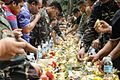 Boodle fight
_02.jpg)
.jpg)

