French press: Difference between revisions
CSV import Tags: mobile edit mobile web edit |
CSV import |
||
| Line 24: | Line 24: | ||
{{coffee-stub}} | {{coffee-stub}} | ||
{{food-stub}} | {{food-stub}} | ||
<gallery> | |||
File:French_press_2020.jpg|Modern French press | |||
File:Cafetiere_1852_(Mayer_&_Delforge).jpg|Cafetiere from 1852 by Mayer & Delforge | |||
File:Use_of_a_coffee_press.ogv|Demonstration of using a coffee press | |||
File:French_press_beaker_and_piston.jpg|French press beaker and piston | |||
File:French_press_filter_bottom_side.jpg|Bottom side of French press filter | |||
File:French_press_filter_upper_side.jpg|Upper side of French press filter | |||
File:Stainless_steel_french_press.png|Stainless steel French press | |||
</gallery> | |||
Latest revision as of 11:14, 18 February 2025
French press or cafetière is a popular method of coffee brewing that originated in France in the mid-19th century. It is known for its simplicity and the rich, full-bodied coffee it produces.
History[edit]
The French press was first patented by Italian designer Attilio Calimani in 1929. However, the design has been modified several times since then, with the most notable changes being made by Swiss inventor Faliero Bondanini in 1958. Bondanini's design, known as the Chambord, is the most widely recognized version of the French press and is still in production today.
Design[edit]
A typical French press consists of a cylindrical glass or plastic beaker, a metal or plastic lid, and a plunger that fits tightly in the cylinder and has a fine wire or nylon mesh filter. The coffee grounds are placed in the beaker, hot water is added, and after letting it steep for a few minutes, the plunger is pressed to separate the grounds from the coffee.
Brewing process[edit]
The brewing process in a French press involves steeping coffee grounds in hot water for a period of time, typically four to five minutes. This allows the coffee to extract more oils and flavors from the grounds than other brewing methods, resulting in a stronger, more robust flavor. After the coffee has steeped, the plunger is pressed down to separate the grounds from the coffee, which is then ready to serve.
Variations[edit]
While the basic design and brewing process of the French press is fairly standard, there are variations. Some French presses are designed to be portable, while others are designed for use in the home. There are also variations in the materials used, with some French presses being made of stainless steel, others of glass, and still others of plastic.
See also[edit]


-
Modern French press
-
Cafetiere from 1852 by Mayer & Delforge
-
Demonstration of using a coffee press
-
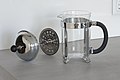 French press beaker and piston
 -
 Bottom side of French press filter
 -
 Upper side of French press filter
 -
 Stainless steel French press


.jpg)