Liberty (apple): Difference between revisions
CSV import |
No edit summary |
||
| (2 intermediate revisions by the same user not shown) | |||
| Line 33: | Line 33: | ||
[[Category:Organic farming]] | [[Category:Organic farming]] | ||
[[Category:Fruit stubs]] | [[Category:Fruit stubs]] | ||
<gallery> | |||
File:Яблоня_сорта_Либерти.jpg|Яблоня сорта Либерти | |||
</gallery> | |||
Latest revision as of 00:35, 17 March 2025
Liberty (apple)
The Liberty apple is a cultivar of apple that was first developed in the United States in the 1970s. It is known for its disease resistance and is often grown in organic and low-spray environments.
History[edit]
The Liberty apple was first developed in 1978 by the New York State Agricultural Experiment Station. It is a cross between the Macoun and Purdue 54-12 apple varieties. The goal of the breeding program was to create a variety that was resistant to apple scab and other common apple diseases.
Characteristics[edit]
The Liberty apple is medium-sized and round, with a skin that is mostly red with some yellow and green streaks. The flesh is crisp and juicy, with a balanced sweet-tart flavor that is often compared to the McIntosh apple.
The tree is a vigorous grower and tends to be very productive. It is resistant to many common apple diseases, including apple scab, cedar apple rust, and fire blight. This makes it a popular choice for organic growers and home gardeners.
Cultivation[edit]
Liberty apples are best grown in USDA hardiness zones 4-7. They require full sun and well-drained soil. The trees are self-fertile, but will produce a larger crop if cross-pollinated with another apple variety.
The apples ripen in late September to early October, depending on the climate. They are good for fresh eating, cooking, and making cider.
See also[edit]
References[edit]
<references />

-
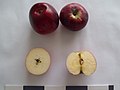 Яблоня сорта Либерти

