Dutchie (doughnut): Difference between revisions
CSV import |
CSV import |
||
| (One intermediate revision by the same user not shown) | |||
| Line 1: | Line 1: | ||
{{Short description|A type of doughnut popular in Canada}} | |||
{{About|the doughnut|other uses|Dutchie (disambiguation)}} | |||
The '''Dutchie''' is a type of [[doughnut]] that | ==Dutchie (doughnut)== | ||
[[File:Tim_Hortons_dutchie.JPG|thumb|right|A Dutchie doughnut from Tim Hortons]] | |||
The '''Dutchie''' is a type of [[doughnut]] that is particularly popular in [[Canada]]. It is a square, yeast-lifted doughnut containing raisins and coated with a sugary glaze. The Dutchie is one of the two original doughnuts that have been offered by [[Tim Hortons]], a well-known Canadian coffee and doughnut chain, since its inception in 1964. | |||
== History == | ==History== | ||
The Dutchie has been a staple in Canadian doughnut culture for decades. It was introduced by Tim Hortons, which was founded by [[Tim Horton]], a professional [[ice hockey]] player, and his partner [[Ron Joyce]]. The chain quickly became a part of Canadian identity, and the Dutchie, with its unique square shape and raisin filling, became one of its signature items. | |||
The Dutchie | ==Ingredients and Preparation== | ||
The Dutchie is made from a [[yeast]]-based dough, which gives it a light and airy texture. The dough is mixed with [[raisins]], which add a sweet and chewy contrast to the soft dough. After the dough is prepared, it is cut into square shapes and deep-fried until golden brown. Once fried, the Dutchie is coated with a sugary glaze that adds a sweet finish to the doughnut. | |||
== | ==Cultural Significance== | ||
The Dutchie holds a special place in Canadian culture, often associated with the quintessential Canadian experience of visiting a Tim Hortons. It is a part of the "double-double" culture, where Canadians enjoy a coffee with two creams and two sugars alongside their doughnut. The Dutchie, with its simple yet satisfying flavor, is a nostalgic treat for many Canadians. | |||
==Decline and Revival== | |||
In recent years, the Dutchie has seen a decline in availability as Tim Hortons has expanded its menu to include a wider variety of items. However, due to popular demand and its iconic status, the Dutchie has made occasional comebacks in select locations and during special promotions. | |||
== | ==Related pages== | ||
* [[Doughnut]] | |||
* [[ | |||
* [[Tim Hortons]] | * [[Tim Hortons]] | ||
* [[Canadian cuisine]] | |||
[[Category:Doughnuts]] | [[Category:Doughnuts]] | ||
[[Category:Canadian cuisine]] | [[Category:Canadian cuisine]] | ||
<gallery> | |||
File:Tim_Hortons_dutchie.JPG|Tim Hortons dutchie | |||
</gallery> | |||
Latest revision as of 11:21, 25 February 2025
A type of doughnut popular in Canada
 This article is about the doughnut.
   For other uses, see Dutchie (disambiguation).
Dutchie (doughnut)[edit]

The Dutchie is a type of doughnut that is particularly popular in Canada. It is a square, yeast-lifted doughnut containing raisins and coated with a sugary glaze. The Dutchie is one of the two original doughnuts that have been offered by Tim Hortons, a well-known Canadian coffee and doughnut chain, since its inception in 1964.
History[edit]
The Dutchie has been a staple in Canadian doughnut culture for decades. It was introduced by Tim Hortons, which was founded by Tim Horton, a professional ice hockey player, and his partner Ron Joyce. The chain quickly became a part of Canadian identity, and the Dutchie, with its unique square shape and raisin filling, became one of its signature items.
Ingredients and Preparation[edit]
The Dutchie is made from a yeast-based dough, which gives it a light and airy texture. The dough is mixed with raisins, which add a sweet and chewy contrast to the soft dough. After the dough is prepared, it is cut into square shapes and deep-fried until golden brown. Once fried, the Dutchie is coated with a sugary glaze that adds a sweet finish to the doughnut.
Cultural Significance[edit]
The Dutchie holds a special place in Canadian culture, often associated with the quintessential Canadian experience of visiting a Tim Hortons. It is a part of the "double-double" culture, where Canadians enjoy a coffee with two creams and two sugars alongside their doughnut. The Dutchie, with its simple yet satisfying flavor, is a nostalgic treat for many Canadians.
Decline and Revival[edit]
In recent years, the Dutchie has seen a decline in availability as Tim Hortons has expanded its menu to include a wider variety of items. However, due to popular demand and its iconic status, the Dutchie has made occasional comebacks in select locations and during special promotions.
Related pages[edit]
-
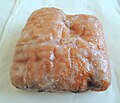 Tim Hortons dutchie
