Kal-guksu: Difference between revisions
CSV import |
CSV import Tags: mobile edit mobile web edit |
||
| Line 24: | Line 24: | ||
{{Korean cuisine}} | {{Korean cuisine}} | ||
{{food-stub}} | {{food-stub}} | ||
<gallery> | |||
File:Pat_kalguksu_(red_bean_noodles).jpg|Red bean noodles | |||
File:Korean.noodles-Kalguksu-Jjolmeyon.jpg|Kalguksu with Jjolmeyon | |||
File:Korean_noodles-Kalguksu-02.jpg|Kalguksu noodles | |||
</gallery> | |||
Latest revision as of 05:02, 18 February 2025
Kal-guksu (Korean knife noodles) is a Korean noodle dish consisting of handmade, knife-cut wheat flour noodles served in a large bowl with broth and other ingredients. It is traditionally considered a seasonal food, consumed most often in summer. Its name comes from the Korean word kal, meaning knife, and guksu, meaning noodles.
History[edit]
The exact origin of Kal-guksu is unknown, but it is believed to have been enjoyed in Korea since the Goryeo dynasty (918–1392). The dish was traditionally made using buckwheat, but wheat flour began to be used after the 18th century.
Preparation[edit]
The noodles for Kal-guksu are made from wheat flour and salt. The dough is rolled out thinly and then cut into long, thin strips. The noodles are then boiled and rinsed in cold water. The broth is typically made from dried anchovies, kelp, and green onion, and can also include zucchini, potatoes, and red pepper flakes for additional flavor. The dish is often garnished with seaweed, sesame seeds, and a raw egg yolk.
Varieties[edit]
There are many regional variations of Kal-guksu across Korea. In Jeju Island, it is common to add seafood to the broth, while in the Gangwon Province, potatoes are often included. Another popular variation is Janchi-guksu, which is served at special occasions such as weddings.
Cultural significance[edit]
Kal-guksu is often associated with the summer season in Korea, as it is traditionally eaten to replace lost energy and nutrients during the hot months. It is also a popular dish during the Chuseok holiday, when families gather to make the noodles together.
See also[edit]
| Korean cuisine 한국 요리
|
|---|
|
[[File:
.jpg) |200px|center|alt=]] |200px|center|alt=]]
|

-
 Red bean noodles
 -
 Kalguksu with Jjolmeyon
 -
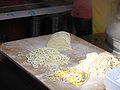 Kalguksu noodles
.jpg)


