Lefse: Difference between revisions
CSV import |
CSV import |
||
| Line 25: | Line 25: | ||
{{Norway-food-stub}} | {{Norway-food-stub}} | ||
{{food-stub}} | {{food-stub}} | ||
<gallery> | |||
File:Lefse_on_a_griddle.jpg|Lefse on a griddle | |||
File:Balls_of_lefse_dough.jpg|Balls of lefse dough | |||
File:Lefse_rolling_pin.jpg|Lefse rolling pin | |||
File:Rakfisk.jpg|Rakfisk | |||
File:Lefse12.jpg|Lefse | |||
File:Pølse_med_lompe.jpg|Pølse med lompe | |||
File:Hardanger_Lefse.jpg|Hardanger Lefse | |||
File:Dessert_Lefse.jpeg|Dessert Lefse | |||
File:Lefse.jpg|Lefse | |||
</gallery> | |||
Latest revision as of 11:19, 18 February 2025
Lefse is a traditional soft, Norwegian flatbread. Made with potatoes, flour, butter, and milk or cream, it is cooked on a large, flat griddle. Special tools are used to prepare lefse, including long wooden turning sticks and special rolling pins with deep grooves.
Ingredients and Preparation[edit]
The main ingredients in lefse are potatoes, flour, butter, and milk or cream. The potatoes are boiled and then mashed or riced. The butter, milk or cream, and salt are added to the potatoes, and the mixture is left to cool. Once cooled, flour is added, and the dough is rolled out into thin, round cakes.
The preparation of lefse is a time-consuming process, often involving several people. The dough is rolled out with a grooved rolling pin, then cooked on a large, flat griddle. A long wooden stick, called a lefse stick, is used to flip the lefse during cooking.
Variations[edit]
There are many variations of lefse within Norway. Some are made with only flour and water, similar to a tortilla, while others include ingredients such as lard or sour cream. The thickness of the lefse can also vary, from paper-thin to pancake-like.
Serving[edit]
Lefse is traditionally served with butter, sugar, and cinnamon, rolled up into a tube. However, it can also be served with a variety of other fillings, such as jam, brown cheese, or lutefisk. It is often eaten as a dessert or snack, but can also be used as a wrap for hot dogs or other foods.
Cultural Significance[edit]
Lefse has a strong cultural significance in Norway, particularly around the holidays. Many Norwegian-Americans also continue the tradition of making lefse, particularly for Thanksgiving and Christmas.
See Also[edit]
 This Norway-food related article is a stub. You can help WikiMD by expanding it.

-
 Lefse on a griddle
 -
 Balls of lefse dough
 -
 Lefse rolling pin
 -
 Rakfisk
 -
 Lefse
Lefse -
 Pølse med lompe
 -
 Hardanger Lefse
 -
 Dessert Lefse
 -
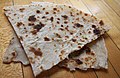 Lefse
Lefse


