Kashk: Difference between revisions
CSV import Tags: mobile edit mobile web edit |
CSV import Tags: mobile edit mobile web edit |
||
| Line 27: | Line 27: | ||
[[Category:Turkish cuisine]] | [[Category:Turkish cuisine]] | ||
{{food-stub}} | {{food-stub}} | ||
<gallery> | |||
File:Mercado_de_Chorsu_03.jpg|Kashk | |||
File:Fromage_kyrghize.jpg|Kashk | |||
File:Kesk-meledi1.jpg|Kashk | |||
File:Kurutob_Tajikistan.JPG|Kashk | |||
File:Milk_tofu.JPG|Kashk | |||
File:Kashk.JPG|Kashk | |||
</gallery> | |||
Latest revision as of 04:59, 18 February 2025
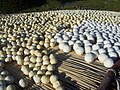
Kashk is a type of dairy product that is used in various cuisines across the Middle East, Central Asia, and the Caucasus. It is made from the leftovers of cheese or yogurt production, and is often used as a seasoning in soups, stews, and other dishes.
History[edit]
The origins of kashk are believed to date back to ancient times, when it was a common way to preserve dairy products. It is mentioned in several historical texts, indicating its widespread use in various cultures.
Production[edit]
Kashk is produced by first making yogurt or cheese, and then allowing the leftover whey to ferment. This fermented whey is then dried and ground into a powder, which can be rehydrated and used in cooking. Some versions of kashk are made from fermented grains, such as barley or wheat, instead of dairy.
Uses[edit]
In Iranian cuisine, kashk is often used as a topping for dishes such as ash reshteh and kashk e bademjan. It is also used in the preparation of kuku sabzi, a type of Iranian frittata. In Turkish cuisine, kashk is known as kashkak and is used in a similar manner.
In Central Asian cuisine, kashk is often used as a base for soups and stews, and is also used to make a type of dumpling known as manti. In the Caucasus, kashk is used in a variety of dishes, including khinkali and kharcho.
See also[edit]

-
 Kashk
Kashk -
 Kashk
Kashk -
Kashk
-
Kashk
-
Kashk
-
Kashk


