Knipp: Difference between revisions
CSV import Tags: mobile edit mobile web edit |
CSV import |
||
| Line 25: | Line 25: | ||
{{German-cuisine-stub}} | {{German-cuisine-stub}} | ||
{{food-stub}} | {{food-stub}} | ||
<gallery> | |||
File:Knipp_1.JPG|Knipp | |||
File:Knipp_auf_Vollkornbrot.jpg|Knipp on whole grain bread | |||
File:Knipp_with_Apple_sauce.jpg|Knipp with apple sauce | |||
</gallery> | |||
Latest revision as of 01:57, 18 February 2025
Knipp is a traditional German dish that originates from the Lower Saxon and Bremen regions of Germany. It is a type of grützwurst, a category of sausage made from a mixture of grain and meat.
History[edit]
The origins of Knipp are traced back to the rural areas of Lower Saxony and Bremen. It was traditionally made by farmers as a way to use up leftover parts of the pig after butchering. The dish is a testament to the frugality and resourcefulness of the rural communities in these regions.
Preparation[edit]
Knipp is made from a mixture of barley grain, pork, offal, and spices. The pork used is typically a combination of lean meat and fatty parts, while the offal can include liver, lungs, and heart. The mixture is stuffed into a casing and then boiled. After boiling, the sausage is usually fried until it is crispy on the outside. It is traditionally served with potatoes and pickles.
Cultural Significance[edit]
Knipp is a staple dish in Lower Saxon and Bremen cuisine. It is often eaten as a hearty meal during the cold winter months. The dish is also a popular choice for Oktoberfest celebrations in these regions.
Variations[edit]
There are several regional variations of Knipp. In the Oldenburg region, the dish is known as Pinkel. Pinkel is similar to Knipp but is made with oat grain instead of barley.
See Also[edit]
This article is a German cuisine stub. You can help WikiMD by expanding it!

-
 Knipp
Knipp -
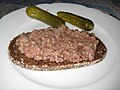 Knipp on whole grain bread
 -
 Knipp with apple sauce


