Elaeocarpus bancroftii: Difference between revisions
CSV import |
CSV import |
||
| Line 24: | Line 24: | ||
{{tree-stub}} | {{tree-stub}} | ||
{{food-stub}} | {{food-stub}} | ||
<gallery> | |||
File:Elaeocarpus_bancroftii.jpg|Elaeocarpus bancroftii | |||
File:Comprehensive_catalogue_of_Queensland_plants,_both_indigenous_and_naturalised._To_which_are_added,_where_known,_the_aboriginal_and_other_vernacular_names;_with_numerous_illustrations,_and_copious_(14779616371).jpg|Elaeocarpus bancroftii | |||
File:Elaeocarpus_bancroftii_trunk_SF21194_1.jpg|Elaeocarpus bancroftii | |||
File:Elaeocarpus_bancroftii_flower_buds_SF21171_2.jpg|Elaeocarpus bancroftii | |||
File:Elaeocarpus_bancroftii_SF21196_16.jpg|Elaeocarpus bancroftii | |||
File:Elaeocarpus_bancroftii_seedling_SF21194_2.jpg|Elaeocarpus bancroftii | |||
File:Elaeocarpus_bancroftii_fruit_and_nuts.jpg|Elaeocarpus bancroftii | |||
File:Elaeocarpus_bancroftii_SF21154_2.jpg|Elaeocarpus bancroftii | |||
File:Elaeocarpus_bancroftii_SF21196_14.jpg|Elaeocarpus bancroftii | |||
File:Elaeocarpus_bancroftii_SF21196_06.jpg|Elaeocarpus bancroftii | |||
File:Elaeocarpus_bancroftii_nut.jpg|Elaeocarpus bancroftii | |||
</gallery> | |||
Latest revision as of 12:05, 18 February 2025
Elaeocarpus bancroftii, also known as Kuranda Quandong or Johnstone River Almond, is a species of flowering plant in the Elaeocarpaceae family. It is native to the rainforests of northeastern Australia, specifically in the region of North Queensland.
Description[edit]
The Elaeocarpus bancroftii is a large tree that can reach up to 45 meters in height. It has a buttressed trunk and large, glossy, dark green leaves. The tree produces white flowers, followed by large, round, blue fruits. The fruits are edible and have a sweet taste, similar to that of almonds.
Distribution and Habitat[edit]
Elaeocarpus bancroftii is endemic to the rainforests of North Queensland, Australia. It is commonly found in the Kuranda region and along the Johnstone River. The tree prefers well-drained soils and is often found in lowland and hillside rainforests.
Uses[edit]
The fruits of the Elaeocarpus bancroftii are edible and have been used by Indigenous Australians as a food source. The wood of the tree is also used in the construction of various items, including tools and furniture.
Conservation[edit]
While the Elaeocarpus bancroftii is not currently listed as a threatened species, its habitat is under threat due to deforestation and climate change. Conservation efforts are focused on protecting its natural habitat and promoting sustainable harvesting practices.
See Also[edit]


-
 Elaeocarpus bancroftii
 -
 Elaeocarpus bancroftii
 -
 Elaeocarpus bancroftii
 -
 Elaeocarpus bancroftii
 -
 Elaeocarpus bancroftii
 -
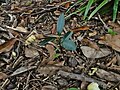 Elaeocarpus bancroftii
 -
 Elaeocarpus bancroftii
 -
 Elaeocarpus bancroftii
 -
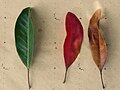 Elaeocarpus bancroftii
 -
 Elaeocarpus bancroftii
 -
 Elaeocarpus bancroftii

.jpg)


