VP40: Difference between revisions
CSV import Tags: mobile edit mobile web edit |
CSV import |
||
| (One intermediate revision by the same user not shown) | |||
| Line 1: | Line 1: | ||
'''VP40''' is a | {{Short description|Protein of the Ebola virus}} | ||
{{Use dmy dates|date=October 2023}} | |||
== Overview == | |||
'''VP40''' is a matrix protein found in the [[Ebola virus]], a member of the [[Filoviridae]] family. It plays a crucial role in the virus's life cycle, particularly in the assembly and budding of new viral particles from the host cell. | |||
== Structure == | == Structure == | ||
VP40 is a | VP40 is a multifunctional protein that can exist in different oligomeric states, including monomers, dimers, and hexamers. The protein's ability to change its conformation is essential for its function in the viral life cycle. The structure of VP40 has been studied extensively using techniques such as [[X-ray crystallography]] and [[nuclear magnetic resonance]] (NMR) spectroscopy. | ||
[[File:4ldd.jpg|thumb|right|Structure of VP40 dimer]] | |||
== Function == | == Function == | ||
VP40 | VP40 is involved in several key processes during the Ebola virus life cycle: | ||
* '''Viral Assembly:''' VP40 interacts with the viral [[genome]] and other viral proteins to facilitate the assembly of new virions. | |||
* '''Budding:''' VP40 is critical for the budding of the virus from the host cell membrane. It interacts with the host cell's [[lipid bilayer]] to form virus-like particles (VLPs) that are released from the cell. | |||
* '''Regulation of Viral Transcription:''' VP40 can modulate the transcription and replication of the viral genome by interacting with other viral proteins and host factors. | |||
== Mechanism of Action == | |||
The mechanism by which VP40 facilitates viral budding involves its ability to bind to the inner leaflet of the host cell membrane. This interaction is mediated by specific lipid-binding domains within the VP40 protein. The protein's oligomerization is also crucial for its function, as it allows VP40 to form a lattice structure that drives membrane curvature and scission, leading to the release of new virions. | |||
[[File:178-EbolaVirusProteins_VP40.png|thumb|right|Illustration of VP40 protein]] | |||
== Research == | == Research and Implications == | ||
Understanding the structure and function of VP40 is vital for developing therapeutic strategies against Ebola virus infections. Inhibitors targeting VP40's interactions with the host cell membrane or its oligomerization could potentially block viral replication and spread. | |||
== | == Related pages == | ||
* [[Ebola virus]] | * [[Ebola virus]] | ||
* [[ | * [[Filoviridae]] | ||
* [[Viral protein]] | * [[Viral matrix protein]] | ||
== References == | |||
{{Reflist}} | |||
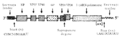
[[File:Genomul.png|thumb|right|Ebola virus genome organization]] | |||
[[Category:Ebola virus]] | |||
[[Category:Viral proteins]] | [[Category:Viral proteins]] | ||
<gallery> | |||
File:4ldd.jpg|VP40 | |||
File:178-EbolaVirusProteins_VP40.png|VP40 | |||
File:Genomul.png|VP40 | |||
</gallery> | |||
Latest revision as of 02:10, 18 February 2025
Protein of the Ebola virus
Overview[edit]
VP40 is a matrix protein found in the Ebola virus, a member of the Filoviridae family. It plays a crucial role in the virus's life cycle, particularly in the assembly and budding of new viral particles from the host cell.
Structure[edit]
VP40 is a multifunctional protein that can exist in different oligomeric states, including monomers, dimers, and hexamers. The protein's ability to change its conformation is essential for its function in the viral life cycle. The structure of VP40 has been studied extensively using techniques such as X-ray crystallography and nuclear magnetic resonance (NMR) spectroscopy.

Function[edit]
VP40 is involved in several key processes during the Ebola virus life cycle:
- Viral Assembly: VP40 interacts with the viral genome and other viral proteins to facilitate the assembly of new virions.
- Budding: VP40 is critical for the budding of the virus from the host cell membrane. It interacts with the host cell's lipid bilayer to form virus-like particles (VLPs) that are released from the cell.
- Regulation of Viral Transcription: VP40 can modulate the transcription and replication of the viral genome by interacting with other viral proteins and host factors.
Mechanism of Action[edit]
The mechanism by which VP40 facilitates viral budding involves its ability to bind to the inner leaflet of the host cell membrane. This interaction is mediated by specific lipid-binding domains within the VP40 protein. The protein's oligomerization is also crucial for its function, as it allows VP40 to form a lattice structure that drives membrane curvature and scission, leading to the release of new virions.

Research and Implications[edit]
Understanding the structure and function of VP40 is vital for developing therapeutic strategies against Ebola virus infections. Inhibitors targeting VP40's interactions with the host cell membrane or its oligomerization could potentially block viral replication and spread.
Related pages[edit]
References[edit]
<references group="" responsive="1"></references>

-
 VP40
VP40 -
 VP40
VP40 -
 VP40
VP40
